Short answer: Your 1031 exchange fails and the gain becomes taxable. The IRS grants no extensions except for federally declared disasters and military service. If you identified property in good faith and the qualified intermediary releases the money in the next tax year, you can generally report the gain as an installment sale in that later year.
Reviewed by Jon Hilley. Last updated September 29, 2026.
The 45-day and 180-day deadlines are the two hard stops in every 1031 exchange timeline. You must identify replacement property in writing by the end of day 45 after your sale closes, and you must acquire it by the earlier of day 180 or your tax return due date (including extensions). Both periods are calendar days, and they do not stretch for weekends or holidays.
Miss either deadline and the exchange fails. The sale is treated as a regular taxable sale, and your capital gain and depreciation recapture are due. What you can still control is when that tax is reported, and that depends on what you identified and when the money comes back to you.
Key rules
- 45 and 180 days: identify within 45 days of the transfer, and receive the property by the earlier of 180 days or the return due date including extensions (IRC §1031(a)(3)).
- Identification must be proper: a written, signed, unambiguous identification delivered to a non-disqualified party before the end of day 45 (Treas. Reg. §1.1031(k)-1(c)(2)-(3)).
- Funds stay locked: if nothing was identified, the QI can release funds after day 45; if property was identified, generally not until you receive everything you are entitled to or the exchange period ends (Treas. Reg. §1.1031(k)-1(g)(6)).
- Installment reporting: a good-faith exchange that fails can generally be reported as an installment sale in the year you receive the cash (Treas. Reg. §1.1031(k)-1(j)(2)).
- Disaster relief only: the IRS can postpone deadlines for federally declared disasters (IRC §7508A; Rev. Proc. 2018-58), and combat zone service has its own relief (IRC §7508).
What happens if you don't identify a property within 45 days?
The 1031 exchange 45-day rule has no grace period. If day 45 passes and you have not delivered a valid identification, the exchange is over. Property you actually close on within the 45 days counts as identified, but nothing else does. Your QI can release the exchange funds after day 45, and the gain is taxable in the year you receive them.
A late identification, a vague one ("a strip center in Phoenix"), or one that exceeds the three-property and 200% limits without meeting the 95% exception is treated as no identification at all. You can change your list until the deadline, but a revocation must also be in writing, signed and delivered to the same party before the end of day 45 (Treas. Reg. §1.1031(k)-1(c)(6)).
What happens if you miss the 180-day deadline?
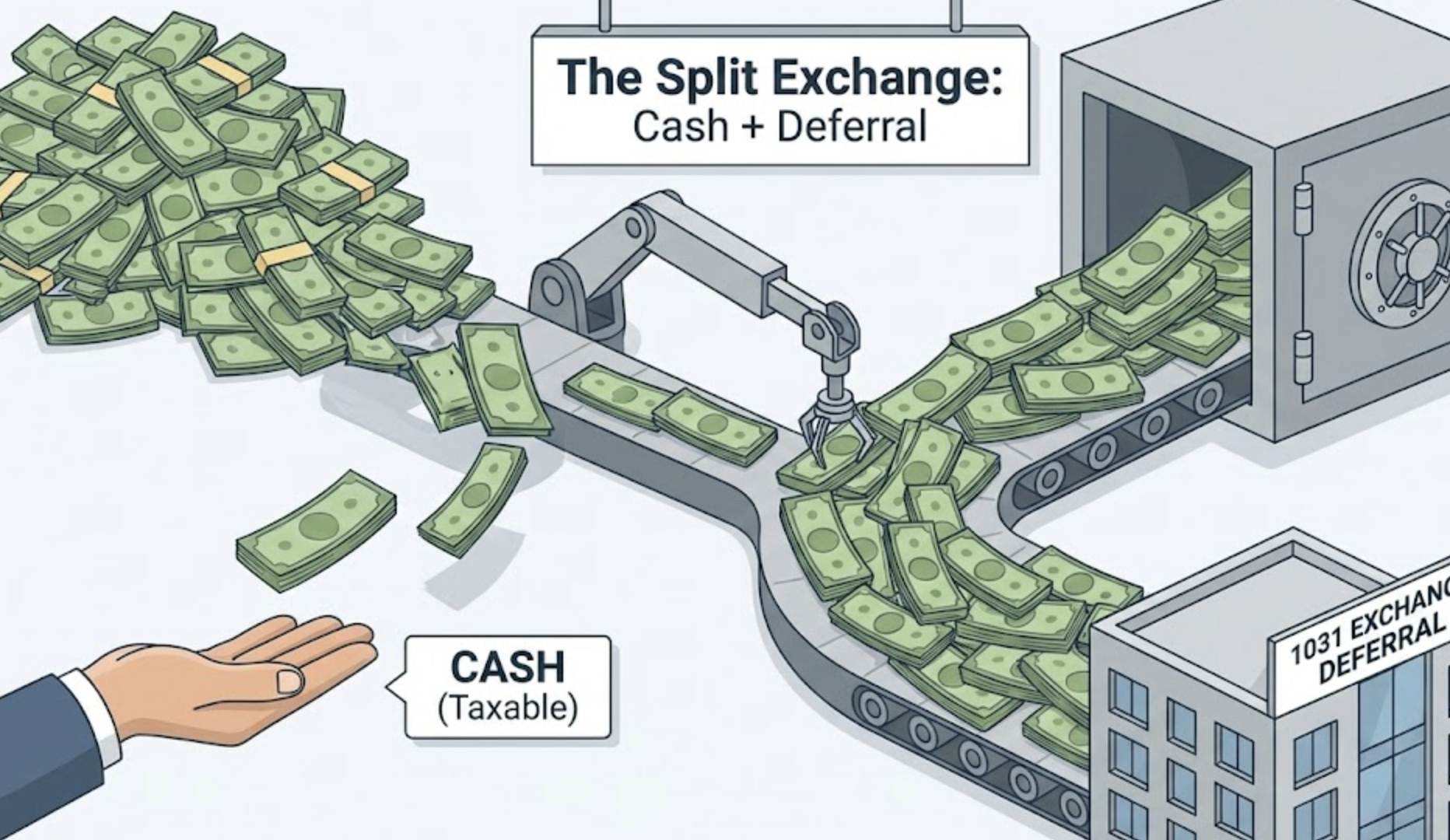
If you identified property but cannot close by day 180, or by your return due date if that comes first, the exchange fails for any property not yet acquired. If you bought some but not all of what you planned, the leftover cash released to you is boot, and you have a partial exchange.
A backup identification helps here. Interests in a Delaware statutory trust are treated as real property (Rev. Rul. 2004-86) and can often close within days, so some investors list one as a fallback when the main deal looks uncertain.
The tax return trap
For a calendar-year individual who sells after mid-October, April 15 arrives before day 180. Unless you file an extension (Form 4868), the exchange period ends on April 15. We see this deadline catch investors more than any other.
Reporting a failed 1031 exchange
A failed exchange is reported as an ordinary sale, generally on Form 4797 for rental or business property. If installment treatment applies because the QI released the money in the following year, the sale is generally reported on Form 6252, with the gain taxed in the year you receive the cash.
Example: a failed exchange that closed in November
- Sale closes: November 2, 2026
- Day 45 (identification deadline): December 17, 2026
- Day 180: May 1, 2027 (the investor files Form 4868; without it the period would end April 15, 2027)
- Sale price, net of selling costs: $600,000
- Adjusted basis: $350,000 (after $100,000 of depreciation)
- Gain: $250,000
- Tax on the $100,000 depreciation portion at 25%: $25,000
- Tax on the other $150,000 at 15%: $22,500
- Net investment income tax at 3.8% on $250,000: $9,500
- Total federal tax: $57,000
Assumptions: the full 25% rate applies to the depreciation portion, a 15% federal capital gains rate and the 3.8% net investment income tax apply to the rest, and state tax is not included. The investor identified two properties by December 17 and both deals fell through. Because property was identified, the QI holds the funds until the exchange period ends on May 1, 2027. The cash is received in 2027, so the $250,000 gain can generally be reported on the 2027 return as an installment sale instead of the 2026 return. Had the investor identified nothing, the funds could have been released after December 17, 2026, and the gain would be taxed in 2026.
Track your own dates with our 1031 exchange deadline tracker.
Other questions investors ask
How long can you delay a 1031 exchange?
Not past day 180, or your tax return due date if that comes first. The IRS does not grant extensions for financing or market problems; only federally declared disasters and certain military service can postpone the deadlines. See Can you extend a 1031 exchange deadline?
What is the 95% rule in a 1031 exchange?
It lets you identify any number of properties of any total value, as long as you actually acquire at least 95% of the combined value of everything you identified. The details, and what happens if you fall short, are in What are the 3-property, 200% and 95% identification rules?
Common mistakes
- Counting business days: we still see investors assume a deadline that lands on a Sunday rolls to Monday. It does not.
- Waiting until day 44 to identify: the most common problem we see is an identification sent at the last minute to the wrong party or with an incomplete address. Send it early to your QI.
- Expecting the QI to release funds early: once you identify property, the regulations generally keep the money with the QI until the exchange period ends, even if every deal falls apart.
- Forgetting the extension: for fall sales, file Form 4868 or you lose the days between April 15 and day 180.