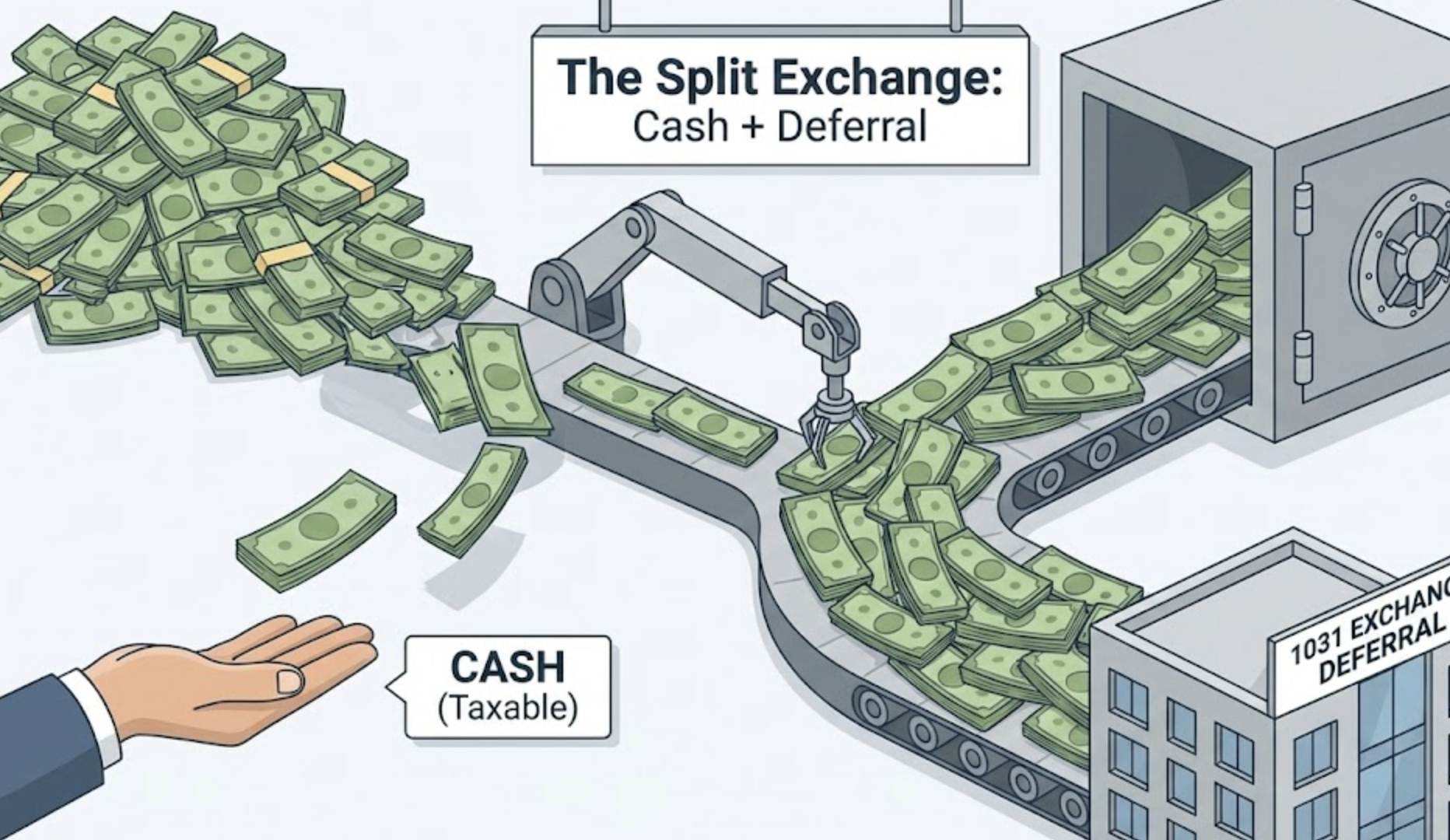
Short answer: Yes. You can sell two or more properties and buy one larger replacement, or sell one and buy several. If the sales are one exchange, the 45-day and 180-day clocks start at the earliest sale. Separate exchanges each get their own clock, and the proceeds can still be combined into one purchase.
Reviewed by Jon Hilley. Last updated September 29, 2026.
A 1031 exchange for multiple properties is common. Investors consolidate several small rentals into one building that is easier to manage, or split one large property into two or three to spread risk. The law doesn't limit how many properties you sell or buy; what matters is that you control the 1031 exchange timeline for every sale and stay within the identification rules.
The key planning decision when you sell several properties is whether to treat them as one exchange or as separate exchanges. That choice decides when your deadlines start.
Key rules
- Deadlines apply to each exchange: identify within 45 days and close within 180 days of transferring the relinquished property, or by your return due date if earlier (IRC §1031(a)(3)).
- One exchange, earliest date controls: when multiple relinquished properties are part of the same exchange, both periods run from the date of the earliest transfer (Treas. Reg. §1.1031(k)-1(b)(2)(iii)).
- Identification limits: up to 3 properties of any value, any number up to 200% of the value of what you sold, or any number if you acquire 95% of what you identified (Treas. Reg. §1.1031(k)-1(c)(4)).
- Same taxpayer on both sides: the taxpayer that sells each property must be the one that buys the replacement, so properties held by different owners can't be pooled into one exchange (IRC §1031(a)(1)).
Selling multiple properties to buy one (a consolidation exchange)
One exchange or separate exchanges?
If you structure two sales as a single exchange, the clock starts at the first closing. A second sale that closes weeks later leaves you less time to identify and close. Setting up a separate exchange agreement for each sale gives each property its own 45 and 180 days. In practice, the proceeds from each exchange can then be applied to the same replacement purchase; work out the allocation with your QI before closing.
Watch who holds title
If one rental is in your name and another is in a multi-member LLC, those are different taxpayers. Each must complete its own exchange and buy its own replacement. A single-member LLC that is disregarded for tax is treated as you, so it can combine with property you own directly.
1031 exchange 1 property for 2 (or more)
Going the other way, often called a diversification exchange, is just as common. You can sell one property and buy two or three, and you don't have to buy every property you identify. The 3-property rule usually covers this, as long as you identify no more than three candidates. If you want to identify more, the total value of everything identified generally has to stay within 200% of your sale price. The 45-day identification validator checks a list against these limits.
To defer all your gain, the combined price of the replacements must be at least your net sale price, you must reinvest all the net cash, and any mortgage paid off must be replaced with new debt or added cash.
How basis is split among multiple replacement properties
When you buy more than one replacement, your carryover basis is generally allocated among them in proportion to their fair market values. That split sets each property's depreciation and the gain when you later sell one of them, so settle the allocation with your tax preparer when the exchange is reported on Form 8824.
Example: two sales into one replacement
Assume no mortgages, prices are net of selling costs, and both sales happen in 2027.
- Property A sale (March 1): $400,000
- Property B sale (April 10): $500,000
- Combined net proceeds: $900,000
- Replacement property price: $950,000 ($900,000 exchange funds + $50,000 of your own cash)
- As one exchange: identify by April 15, close by August 28 (both counted from March 1)
- As separate exchanges: Property A deadlines April 15 and August 28; Property B deadlines May 25 and October 7
As a single exchange, you would have only 5 days after Property B closes to identify the replacement. With separate exchanges, Property B keeps its full 45 days. Either way, because you bought $950,000 of property with all $900,000 of proceeds and no debt was relieved, the gain on both sales is fully deferred. Note that the Property A replacement must still close by August 28, so buying one property for both usually means closing by the earlier deadline. Use the 1031 exchange deadline tracker to map your own dates.
Other questions investors ask
How many properties can you buy in a 1031 exchange?
There is no limit on how many replacement properties you buy. The limit is on how many you identify within 45 days: three of any value, more if their combined value stays within 200% of what you sold, or any number if you acquire at least 95% of the value identified.
What is the 3 property rule in a 1031 exchange?
It lets you identify up to three replacement properties regardless of their value, then buy one, two or all three. It is the rule most multi-property buyers use. See What are the 3-property, 200% and 95% identification rules?
What is the 95% rule in a 1031 exchange?
If you identify more than three properties and exceed 200% of your sale value, the identification still works only if you actually acquire at least 95% of the total value you identified. Missing one purchase usually breaks it, so we rarely recommend relying on it (Treas. Reg. §1.1031(k)-1(c)(4)).
Common mistakes
- Letting the first sale set everyone's clock: we see investors lump staggered sales into one exchange and then discover the identification deadline has almost passed on the later sale.
- Mixing owners: a property held by a partnership and one held individually can't fund one exchange. Check vesting on every deed before listing.
- Over-identifying on the purchase side: when splitting into several properties, investors sometimes list five or six candidates and exceed 200% of the sale value, which voids the identification unless they buy 95% of it.