How to "Take Some Chips Off the Table" Without Killing Your Tax Break
There is a pervasive myth in the real estate community that the 1031 exchange is an "all-or-nothing" proposition. Investors believe they face a binary choice: either reinvest 100% of their proceeds to defer all taxes, or sell, pay the massive tax bill, and keep the cash.
This black-and-white thinking costs investors millions of dollars every year.
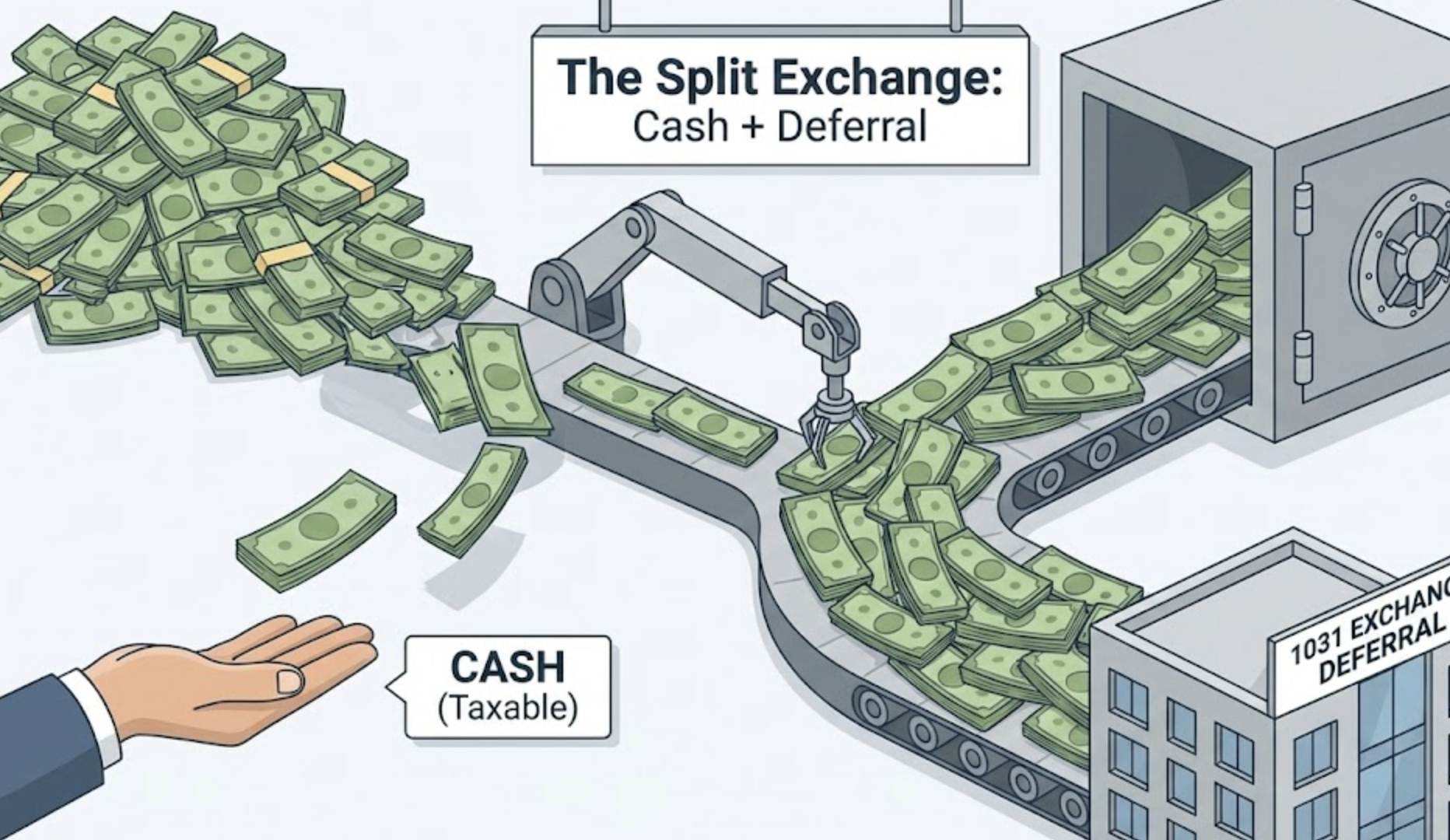
The reality is that Section 1031 allows for shades of grey. This is known as a Partial Exchange or a Split Exchange.
You can reinvest most of your equity to defer the bulk of your taxes while keeping a portion of the cash—"Boot"—for yourself. Whether you need $50,000 for a child’s tuition, $200,000 to pay off high-interest personal debt, or simply want to diversify into the stock market, a Split Exchange allows you to access liquidity without abandoning the tax shelter entirely.
However, the IRS has a specific (and punitive) way of taxing that cash. It is not pro-rated. It works on a "Cream off the Top" principle that catches many off guard.
This article details the mechanics of the Split Exchange, the "Tax Waterfall" calculation you must understand, and the strategic alternatives that might get you the cash for free.
The "Cream off the Top" Rule
The most dangerous misconception about a partial exchange is the idea of "pro-rating."
The Myth:
- You sell a building for $1,000,000.
- Your Cost Basis is $500,000.
- Your Capital Gain is $500,000 (50% of the sale price).
- The Mistake: You assume that if you keep $100,000 of cash (10% of the sale), only 50% of it is taxable gain ($50k) and the other 50% is return of basis ($50k).
The Reality (The Law): Section 1031(b) states that any "boot" (cash or non-like-kind property) received is taxable to the extent of the realized gain.
The IRS views the first dollar you touch as pure profit. You do not get your "basis" back until you have paid tax on every dollar of profit.
- In the example above, if you keep $100,000 cash, 100% of it is taxable.
- You owe capital gains tax on the full $100,000.
- You defer the remaining $400,000 of gain into the new property.
This is the "Cream off the Top." You are skimming the taxable profit first.
The "Tax Waterfall": Which Rate Do You Pay?
It gets worse. Not all gain is created equal. When you take cash out of a deal, the IRS applies the highest tax rates first. This is known as the Recapture Trap.
Your total gain is usually a mix of:
- Depreciation Recapture (Taxed at max 25%).
- Federal Capital Gains (Taxed at 15% or 20%).
- Net Investment Income Tax (NIIT) (Taxed at 3.8%).
The Calculation: If you have $100,000 of accumulated depreciation on your old property and you take $100,000 of cash boot:
- The IRS deems that the cash you took is the Recapture portion.
- You pay 25% federal tax on that $100k, not the lower 15% or 20% rate.
- Result: Taking $100,000 cash might cost you $35,000+ in immediate taxes (Federal + State).
Key Takeaway: Boot is expensive. You are effectively withdrawing your "worst" money first.
Strategic Uses for a Split Exchange
Despite the tax hit, there are times when a Split Exchange is the smartest move.
1. The "Offset" Strategy (Suspended Losses)
This is the holy grail of partial exchanges. If you have Suspended Passive Losses carried over from previous years (e.g., a rental property that lost money on paper for a decade), you can use those losses to offset the gain from the boot.
- Scenario: You have $50,000 in suspended passive losses.
- The Move: You do a partial exchange and take $50,000 in cash boot.
- The Magic: The $50,000 gain is canceled out by the $50,000 loss.
- Result: You get $50,000 tax-free cash in your pocket.
2. Eliminate "Bad Debt"
If you have personal debt (credit cards at 22% interest), paying 25% tax once to eliminate 22% compounding interest forever is often a sound financial decision.
- Math: Taking $100k to pay off debt costs you $25k in tax. But saving $22k/year in interest pays for the tax hit in just over one year.
3. Diversification
If 100% of your net worth is in real estate, taking a 25% tax hit to move $200k into the S&P 500 or a high-yield savings account provides safety. You are paying for liquidity and peace of mind.
The "Refinance" Alternative: The Better Way?
Before you choose a Split Exchange, consider the "Refinance Later" strategy.
Option A: Split Exchange (Cash Now)
- Sell for $1M.
- Keep $200k cash.
- Buy replacement for $800k.
- Consequence: You pay ~$60,000 in taxes immediately. You have $140,000 net cash.
Option B: Full Exchange + Refinance (Cash Later)
- Sell for $1M.
- Reinvest all $1M into the replacement property. (Defer 100% of tax).
- Wait 6–12 months.
- Do a Cash-Out Refinance on the new property and pull out $200k.
- Consequence: Loan proceeds are tax-free. You pay $0 in taxes. You have the full $200k in your pocket.
The Risk: You must be able to qualify for the loan, and the property must appraise high enough. Also, you generally should not refinance immediately after closing, or the IRS may view it as a disguised sale (Step Transaction). Most advisors recommend waiting 6 months to "season" the property.
The "Boot" You Didn't Ask For
Sometimes, a Split Exchange happens by accident. This is called Inadvertent Boot.
1. The "Lender Credit" Trap
If your lender gives you a credit at closing for interest rate buydowns or repairs, and that credit results in you bringing less cash to the table than required, the excess exchange funds might be returned to you. That is taxable boot.
2. Prorated Rents & Deposits
Standard real estate contracts usually credit the buyer (you) for prorated rents and security deposits.
- Example: You buy an apartment building. The closing statement shows a credit to you of $10,000 for tenant deposits.
- Because this reduces the cash you need to bring, the Qualified Intermediary (QI) sends $10,000 less to the closer.
- Technically, you "received" that $10,000 benefit. It is taxable boot unless you put $10,000 of your own cash into the deal to balance it.
People Also Ask (FAQ)
Can I use the cash boot to pay the real estate agent commissions? Yes! This is a critical distinction.
- Selling Expenses (Commissions, Title Insurance, Recording Fees, Transfer Taxes) reduce your "Realized Gain."
- If you use $50,000 of the sale proceeds to pay your broker, that is not taxable boot. It is a deductible expense of the sale. You only pay tax on the net cash you keep after paying closing costs.
When do I have to decide how much cash to keep? You must decide at the closing of the Relinquished Property (the sale) or at the closing of the Replacement Property (the purchase).
- Sale: You can tell the QI, "Give me $50,000 now and hold the rest." (Taxable in the year of sale).
- Purchase: You can tell the QI, "Only send $900k to the closing; return the remaining $100k to me." (Taxable in the year the cash is received).
Does boot affect my future basis? Yes. Since you paid tax on the boot, your basis in the new property is adjusted. Essentially, you "bought back" some of your basis. This means if you sell the new property later, your tax bill will be slightly lower because you already prepaid some of it on the boot.
Can I take cash out to pay for repairs on the new property? No. If you take $50,000 out of the exchange account to put a new roof on the replacement property, the IRS views that as Taxable Boot.
- Why: You received cash. What you did with it (bought a roof) doesn't matter.
- Workaround: Do an Improvement Exchange (Construction Exchange) where the QI holds the money and pays the roofer directly. This keeps the funds tax-deferred.
Final Thoughts: The Liquidity Price Tag
A Split Exchange is a valid tool, but it is an expensive one. You are essentially borrowing money from yourself at a 25–35% interest rate (the tax cost).
Key Takeaway:
- Calculate the Tax First: Do not guess. Have your CPA run a mock return to see exactly how much tax the boot will trigger (remembering the Recapture Trap).
- Check for Losses: Look for suspended passive losses to offset the hit.
Consider the Refi: If you can wait 6 months, refinancing the new property is almost always mathematically superior to taking boot.