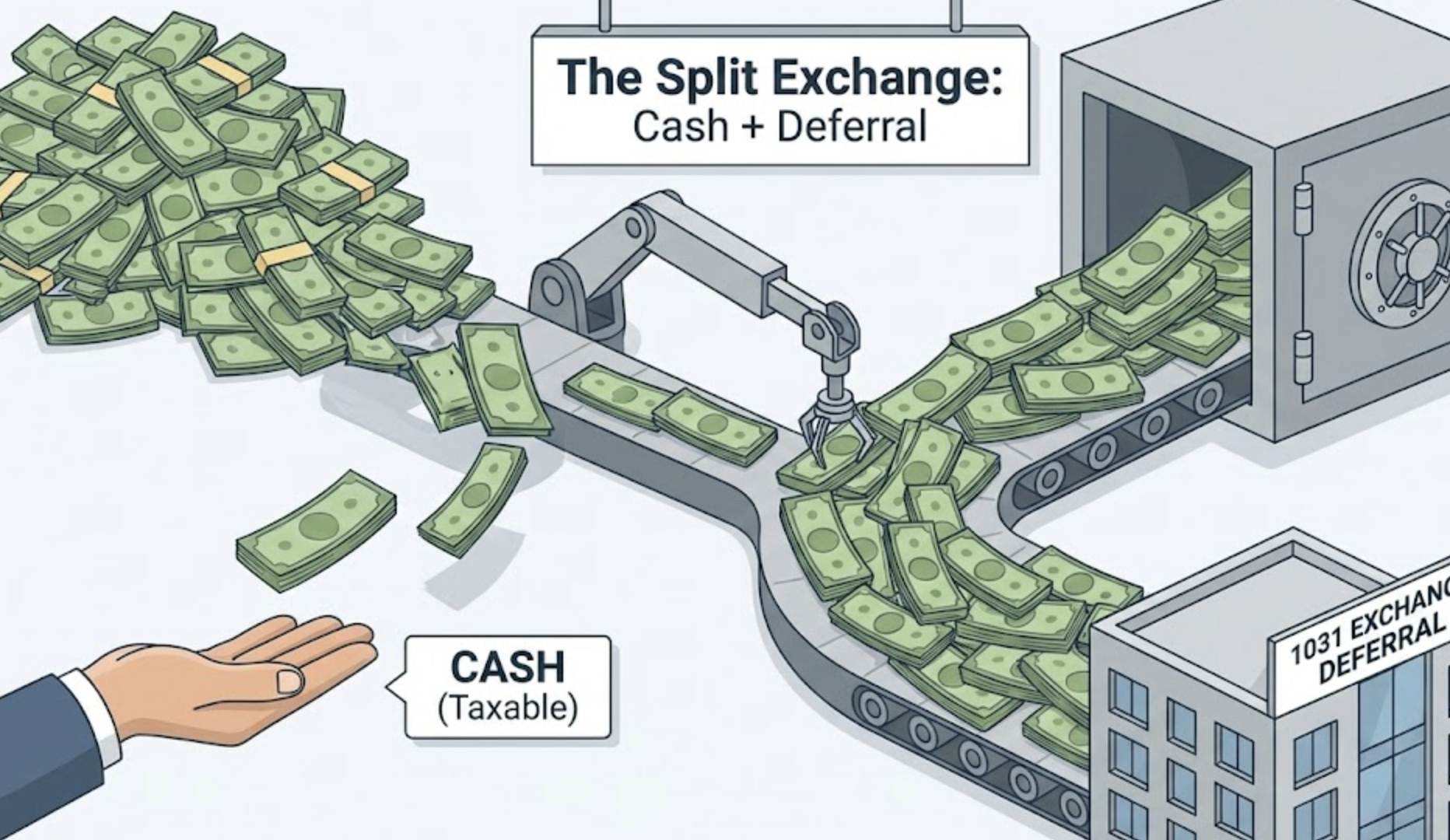
A 1031 exchange in Mississippi lets you sell investment real estate and reinvest in like-kind property while deferring the tax on the gain. The federal rules apply the same way everywhere. Mississippi adds a flat state tax on the gain that is being phased down toward elimination, and a nonresident withholding step at closing. We act as your qualified intermediary, holding the proceeds and handling the documentation so the exchange holds from sale to closing.
Table of contents
- How much is capital gains tax on real estate in Mississippi?
- Mississippi's nonresident withholding
- Mississippi 1031 exchange rules and timeline
- 1031 exchanges across Mississippi markets
- Common Mississippi 1031 exchange mistakes
- Start your Mississippi 1031 exchange
- Frequently asked questions
How much is capital gains tax on real estate in Mississippi?
Mississippi taxes the gain as ordinary income at a flat rate of around 4% for 2026, and the state has enacted a path to reduce the income tax further over time, ultimately toward elimination if revenue conditions are met, so confirm the current figure for your year. That rate sits on top of the federal tax an exchange also defers:
- Long-term capital gains at 0%, 15%, or 20%, with the 20% rate applying above $545,500 of taxable income for single filers and $613,700 for married couples filing jointly in 2026.
- The 3.8% Net Investment Income Tax above $200,000 of modified adjusted gross income for single filers, $250,000 for married couples.
- Depreciation recapture, taxed as unrecaptured Section 1250 gain at up to 25%.
- Mississippi's flat rate on the gain.
Mississippi conforms to Section 1031, so a properly structured exchange defers both the federal and the Mississippi tax. The full federal framework is in our main 1031 exchange guide.
Mississippi's nonresident withholding
When a nonresident sells Mississippi real estate, the buyer generally withholds 5% of the gain on the sale, and remits it to the state. It is a prepayment against the Mississippi tax, not an extra tax. In a 1031 exchange where no gain is recognized, the seller documents the like-kind exchange, supported by your intermediary's records, so there is no gain to withhold on. Confirm the current withholding form and procedure with your closing agent.
Mississippi 1031 exchange rules and timeline
The federal deadlines govern, and they are strict:
- 45-day identification. Identify replacement property in writing within 45 days of the sale.
- 180-day closing. Close within 180 days of the sale, or by your return due date including extensions, whichever is earlier.
- No constructive receipt. Proceeds go to your qualified intermediary, never to you.
- Equal or greater value and debt. Reinvest all net proceeds and match or exceed the relinquished value and debt, or the shortfall is taxable boot.
- Same taxpayer. The entity that sold must be the entity that buys.
1031 exchanges across Mississippi markets
Mississippi's exchange activity spreads across several markets. Jackson, the capital and largest metro, anchors commercial and multifamily demand. The Gulf Coast around Biloxi and Gulfport combines a gaming and tourism economy with coastal and hospitality-linked property. DeSoto County, in the northwest corner, functions as a fast-growing suburban extension of the Memphis metro and carries strong residential, multifamily, and logistics demand. Tupelo adds a manufacturing base, and Oxford, home to the University of Mississippi, supports a student-housing and commercial market. Mississippi property tax is low, which supports replacement-property yields, though you should confirm the rate for any specific deal.
Common Mississippi 1031 exchange mistakes
- Not documenting the exchange, so 5% of the gain is withheld and tied up.
- Taking receipt of the proceeds, even briefly, which disqualifies the exchange.
- Missing the 45-day identification window.
- Trading down or pulling cash out, which creates taxable boot.
Start your Mississippi 1031 exchange
Set up your exchange before your relinquished property closes, so the withholding is handled and the proceeds never reach your hands. Contact our team to begin, or to talk through a specific deal.
Frequently asked questions
How much is capital gains tax on real estate in Mississippi?
Mississippi taxes the gain as ordinary income at a flat rate of around 4% for 2026, which is being phased down toward elimination, on top of federal capital gains tax.
Is there nonresident withholding when I sell Mississippi property?
Yes. The buyer generally withholds 5% of the gain from a nonresident seller. In a 1031 with no recognized gain, there is no gain to withhold on.
Does Mississippi conform to federal 1031 rules?
Yes. A properly structured exchange defers both the federal and the Mississippi tax.
Do I need a qualified intermediary for a Mississippi 1031 exchange?
Yes. The intermediary must hold the proceeds and facilitate the exchange. Engage one before the relinquished property closes.
This page is general information, not tax or legal advice. We act as a qualified intermediary and do not provide tax or legal advice. State and federal rules and thresholds change, and Mississippi's rate is being phased down; confirm current figures with your tax advisor.