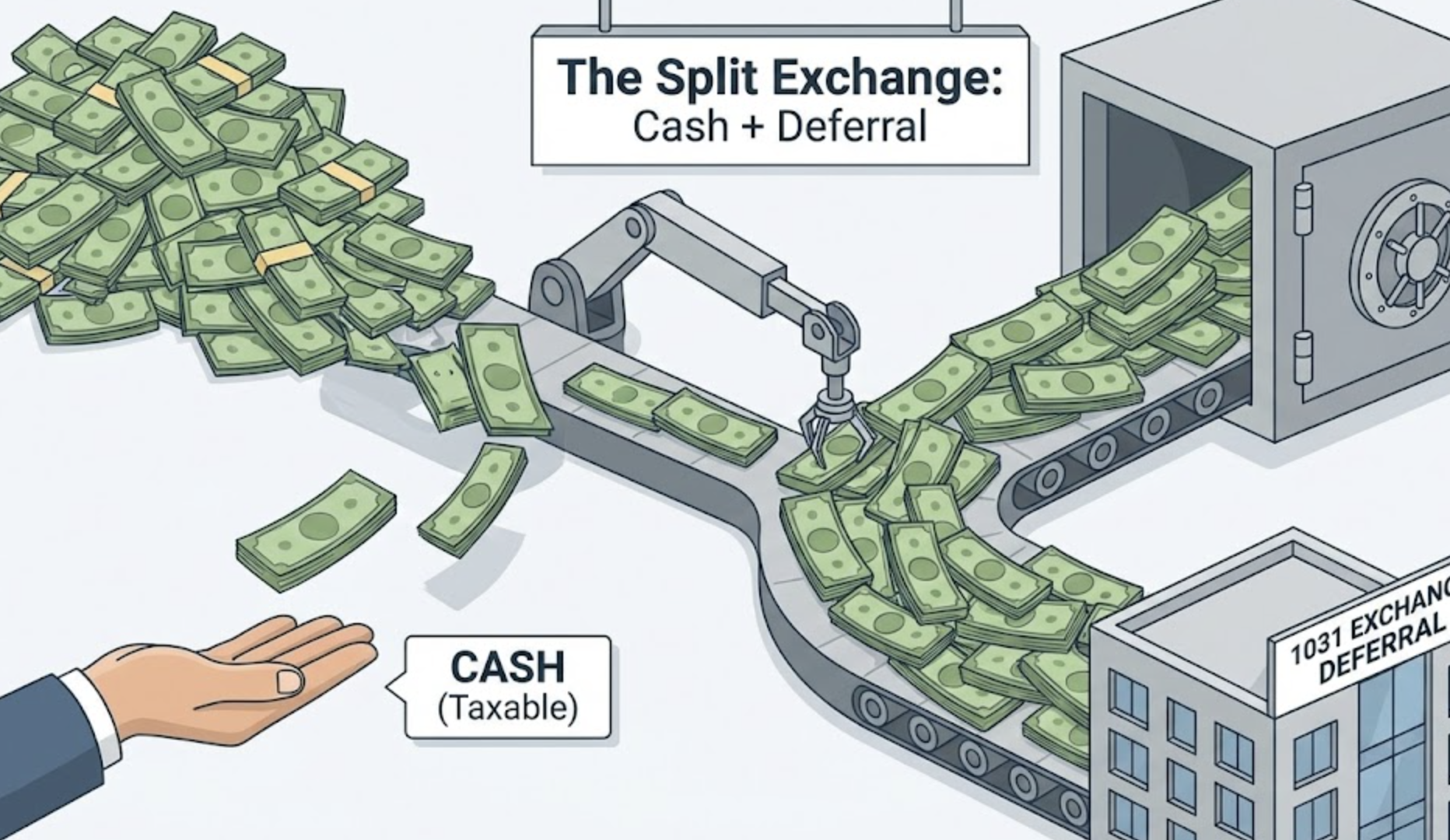
Alabama is one of the few states that lets individuals deduct the federal income tax they pay, which softens its 5% top rate on real estate gains. Alabama capital gains tax on real estate is otherwise simple: gain is ordinary income, and almost every investor sale lands in the 5% bracket. A 1031 exchange Alabama investors complete defers both that state tax and the larger federal bill, and it also switches off the 3% or 4% nonresident withholding at closing.
Reviewed by Jon Hilley, CEO & Founder of 1031 Specialists. Last reviewed September 29, 2026.
| State tax on real estate gains | 2%, 4% and 5% brackets; 5% on taxable income over $3,000 single or $6,000 joint |
|---|---|
| Long-term capital gains treatment | Taxed as ordinary income; federal income tax paid is deductible on the Alabama return |
| Nonresident withholding at closing | 3% or 4% of the purchase price, or of the gain with an affidavit |
| Withholding form | Forms WNR and WNR-V (buyer); NR-AF1 residence, NR-AF2 gain and NR-AF3 exemption affidavits (seller) |
| Transfer or conveyance tax (a 1031 does not defer it) | Deed tax $0.50 per $500 of value; mortgage tax $0.15 per $100 of debt |
| Clawback on out-of-state replacement property | None |
| Conforms to Section 1031 | Yes, withholding rules expressly exempt gain not recognized in a like-kind exchange |
Table of contents
- How much is capital gains tax on real estate in Alabama?
- Alabama tax on a $300,000 gain: worked example
- Alabama nonresident withholding and the 1031 exemption
- Alabama deed and mortgage taxes
- Alabama conformity and clawback
- Using the federal tax deduction when you do not exchange
- Moving into or out of Alabama
- Where Alabama 1031 exchanges happen
- Federal 1031 rules in brief
- Common Alabama 1031 exchange mistakes
- Start your Alabama exchange with 1031 Specialists
- Frequently asked questions
- Sources
How much is capital gains tax on real estate in Alabama?
Alabama taxes gain on property as ordinary income using three brackets. For single filers: 2% on the first $500 of taxable income, 4% on the next $2,500 and 5% on everything above $3,000. Joint filers get double-width brackets: 2% on the first $1,000, 4% on the next $5,000 and 5% above $6,000. In practice every dollar of a meaningful real estate gain is taxed at 5%.
Two features make Alabama different from its neighbors:
- Federal income tax deduction. Under Amendment No. 225 to the Alabama Constitution, individuals deduct federal income taxes paid. A large federal bill on a sale therefore lowers the Alabama taxable income, which pulls the effective state rate below 5%.
- No long-term discount. Alabama does not exclude any part of long-term gain, and depreciation recapture is taxed like the rest.
Some cities, including Birmingham, levy occupational taxes, but those apply to wages and business earnings, not to gain on selling investment property.
Alabama tax on a $300,000 gain: worked example
Assumptions: a $300,000 long-term gain on an Alabama rental, $100,000 of it unrecaptured §1250 depreciation, joint filers already in the top federal bracket and the 5% Alabama bracket. The state line below is 5% of $300,000 before the federal income tax deduction; the deduction usually trims it, but by how much depends on when the federal tax is paid and your other income.
| Unrecaptured §1250 gain: 25% on $100,000 | $25,000 |
|---|---|
| Long-term capital gain: 20% on $200,000 | $40,000 |
| Net investment income tax: 3.8% on $300,000 | $11,400 |
| Federal subtotal | $76,400 |
| Alabama tax: 5% x $300,000 (before federal tax deduction) | $15,000 |
| Total deferred by a full 1031 exchange | up to $91,400 |
If you deduct, say, $65,000 of federal tax paid on the gain in the same year, Alabama taxable income falls by $65,000 and the state tax drops by $3,250. Run your recapture number in the depreciation recapture calculator and the whole deal in the 1031 exchange calculator.
Alabama nonresident withholding and the 1031 exemption
Under Section 40-18-86 of the Code of Alabama, a buyer purchasing Alabama real property from a nonresident must generally withhold 3% or 4% of the purchase price, depending on the type of seller, and report it on Form WNR with voucher WNR-V. The seller can limit withholding to the gain by signing Form NR-AF2, and withholding never exceeds the net proceeds.
The Department of Revenue says directly that transfers under a Section 1031 exchange, where gain is realized but not recognized for Alabama purposes, are not subject to withholding. The seller documents this on Form NR-AF3, the certificate of exemption. Two details apply to deferred exchanges:
- If you take boot, withholding applies to the recognized part of the gain.
- The qualified intermediary must agree to file the withholding vouchers if exchange funds are still unspent after 180 days, which is why the intermediary's paperwork goes to the closing agent with the affidavit.
Alabama residents sign NR-AF1 to confirm no withholding applies. Foreign sellers should also read our FIRPTA guide.
Alabama deed and mortgage taxes
Alabama calls its transfer charges recordation taxes, collected by the probate judge when the deed or mortgage is recorded. A 1031 does not defer them.
- Deed tax: $0.50 per $500 of value, or $1 per $1,000. A $750,000 sale costs $750.
- Mortgage tax: $0.15 per $100 of debt on the replacement loan. A $500,000 loan costs $750.
The contract sets who pays. Compared with Florida's doc stamps these are small, one reason Alabama replacement property is cheap to buy into.
Alabama conformity and clawback
Alabama follows federal like-kind exchange treatment, and its withholding rules are written around it. There is no clawback: exchange Alabama property into a Florida or Tennessee building and Alabama does not track the deferred gain. Nonresidents owe Alabama only on gain recognized from Alabama property.
Using the federal tax deduction when you do not exchange
Because Alabama allows a deduction for federal income taxes paid, partial exchanges are cheaper here than in most states. If you take $100,000 of boot and pay federal tax on it, that federal tax reduces your Alabama taxable income. The deduction follows the year the federal tax is paid, so a sale late in the year with the federal balance paid the following April may push the deduction into the next Alabama return. Plan estimated payments with your CPA. Our partial 1031 boot calculator shows the federal side.
Moving into or out of Alabama
Alabama taxes nonresidents on Alabama real estate gain, which is why withholding exists. Retirees moving from Alabama to Florida often exchange Alabama rentals into Florida property to defer the gain and escape future Alabama tax on it. Investors arriving from California should remember that California's FTB 3840 tracking follows exchanged property into Alabama. Tennessee, with no income tax on wages or gains, is another common destination.
Where Alabama 1031 exchanges happen
Huntsville leads for growth, with defense, aerospace and federal work filling flex, office and multifamily space. Birmingham carries the most multifamily and medical property, Mobile trades in industrial and port-related buildings, and Baldwin County and Gulf Shores deal mainly in vacation rentals and small retail. Montgomery and Tuscaloosa add workforce and student housing.
Federal 1031 rules in brief
Identify replacement property within 45 days and close within 180 days of the sale, or by your tax return due date if earlier. A qualified intermediary holds the funds. Buy equal or greater value, reinvest all cash and replace retired debt to defer everything. See our 1031 exchange guides and check your list with the 45-day identification validator.
Common Alabama 1031 exchange mistakes
- Signing NR-AF2 when NR-AF3 applies. The gain affidavit still triggers withholding; the exemption certificate is what covers a full exchange.
- Ignoring the 180-day voucher duty. If the exchange fails, withholding is due on funds left with the intermediary.
- Treating a Gulf Shores condo as investment property with little rental history.
- Overstating the state bill. Estimates that skip the federal tax deduction make selling outright look worse than it is, so run both cases.
Start your Alabama exchange with 1031 Specialists
We prepare the exchange agreement and supporting letter for the NR-AF3, hold funds in a segregated account and track your deadlines. Start your exchange or book an intro call.
Frequently asked questions
What is the capital gains tax rate on real estate in Alabama?
Alabama taxes capital gains as ordinary income. The top rate of 5% applies to taxable income over $3,000 for single filers and $6,000 for joint filers, and federal income tax paid is deductible on the Alabama return.
How can I avoid capital gains tax on real estate in Alabama?
A 1031 exchange into other investment real estate defers both the Alabama and federal tax. For a primary residence, the Section 121 exclusion may apply. Holding exchanged property until death can let heirs receive a stepped-up basis.
How much does Alabama withhold from nonresident sellers?
Generally 3% or 4% of the purchase price, depending on the type of seller, reported on Form WNR. The seller can limit it to the gain with Form NR-AF2, and a seller completing a 1031 exchange can claim exemption on Form NR-AF3.
Is there a real estate transfer tax in Alabama?
Yes. The deed tax is $0.50 per $500 of value and the mortgage tax is $0.15 per $100 of debt. A 1031 exchange does not defer them.
Does Alabama follow federal 1031 exchange rules?
Yes. Gain deferred federally is not recognized for Alabama purposes, and Alabama has no clawback on out-of-state replacement property.
Sources
- Alabama DOR: individual income tax rates
- Alabama DOR: individual income tax (federal tax deduction)
- Alabama DOR: nonresident real property withholding
- Alabama DOR: FAQs on withholding for nonresident real property sales
- Alabama DOR: recordation tax
- IRS: About Form 8824
Related: Florida, Georgia, Tennessee, Mississippi and all 50 states.
General information only, not tax or legal advice. Alabama rules and forms change; confirm your sale with a CPA or attorney.