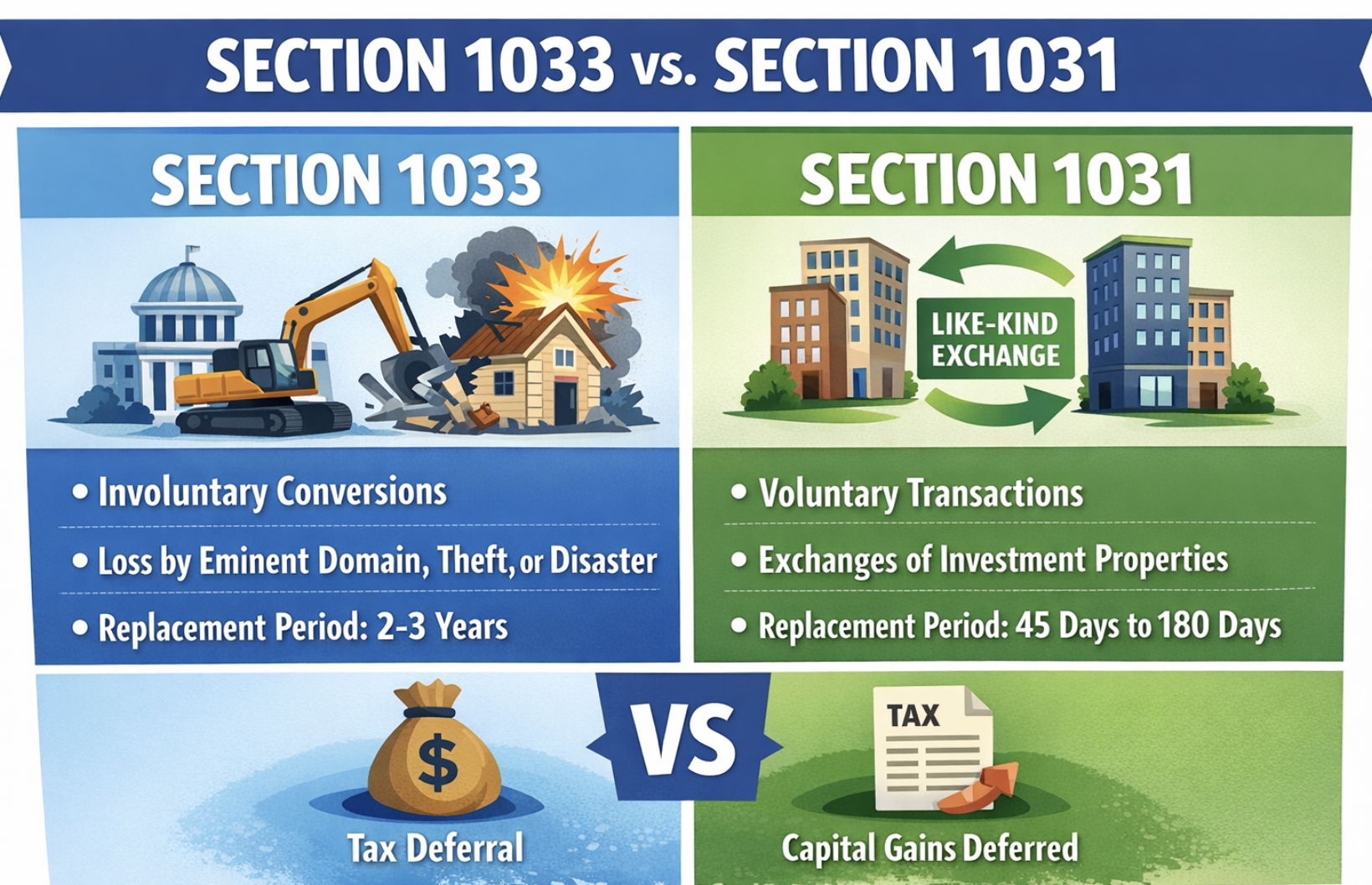
Short answer: A 1031 exchange defers tax on a voluntary sale, while a 1033 exchange defers tax only when property is involuntarily converted, such as by condemnation, fire or theft. A 1033 gives you two to four years to reinvest, needs no intermediary and lets you hold the proceeds. A 1031 has strict 45-day and 180-day deadlines.
Reviewed by Jon Hilley. Last updated September 29, 2026.
Both sections let you defer tax on gain from real estate by reinvesting, but they cover different events. Section 1031 applies when you choose to sell. Section 1033 applies when the property is taken from you or destroyed, and it is one of the most useful 1031 exchange alternatives because its rules are far more forgiving.
If your property is being condemned or was damaged in a casualty, a 1033 exchange is usually the right tool. If you are selling on the open market, you need a 1031 exchange, because a 1033 cannot be used for a voluntary sale.
Key rules
- 1033 requires an involuntary conversion: Destruction, theft, seizure, condemnation or the threat or imminence of condemnation (IRC §1033(a))
- Two-year general replacement period: It runs until two years after the close of the first tax year in which any gain is realized (IRC §1033(a)(2)(B))
- Three years for condemned business or investment real estate: The period is extended for real property held for business or investment (IRC §1033(g)(4))
- Four years for a main home in a disaster area: A principal residence in a federally declared disaster area gets a longer period (IRC §1033(h)(1)(B))
- Replacement standard: Generally "similar or related in service or use," but the broader like-kind standard applies to condemned business or investment real property (IRC §1033(a); IRC §1033(g))
- 1031 deadlines are much shorter: 45 days to identify and 180 days to close, with a qualified intermediary holding the funds (IRC §1031(a)(3); Treas. Reg. §1.1031(k)-1(g)(4))
What are the key differences between a 1031 exchange and a 1033 exchange?
What triggers it
A 1031 exchange starts with a voluntary sale of property held for investment or business use. A 1033 exchange starts with an involuntary conversion. A sale to a government agency under threat of condemnation counts, but a sale forced by finances, a divorce or a partner dispute does not.
Deadlines
In a 1031 exchange you have 45 days to identify replacement property in writing and 180 days to close. A 1033 exchange has no identification requirement, and the replacement period is measured in years from the end of the tax year in which you realize gain, not from the day of the loss. The window opens at the earlier of the conversion or the first threat of condemnation, so property you bought before the threat does not count (IRC §1033(a)(2)(B)).
Handling the money
In a 1031 exchange you cannot touch the sale proceeds; a qualified intermediary must hold them. In a 1033 exchange you can receive the condemnation award or insurance money directly, keep it in your own account and reinvest it later.
What you must buy
A 1031 exchange uses the like-kind standard, so any US investment or business real estate works. The general 1033 standard, similar or related in service or use, is narrower. For condemned business or investment real estate, though, Section 1033(g) applies the like-kind standard, so a condemned warehouse can be replaced with an apartment building. Section 1033 also lets you replace by buying control (at least 80%) of a corporation that owns qualifying property (IRC §1033(a)(2)(A)). If you are a C corporation, or your realized gain from conversions for the year is more than $100,000, you generally cannot buy the replacement from a related person (IRC §1033(i)).
How much gain is taxed
Under Section 1033, you recognize gain to the extent the amount you realize exceeds the cost of the replacement property. Under Section 1031, you recognize gain to the extent of boot, which includes cash you take out and net debt relief.
Because the 1033 test compares the amount you realize with the cost of the replacement, money you borrow to buy it counts toward that cost. So you can keep part of the award without recognizing gain if you finance enough of the purchase, although the lower basis carries the deferred gain forward. In a 1031 exchange, cash you take out is taxable boot even if you buy a more expensive property with new debt.
How do you report a 1033 exchange on your tax return?
A 1031 exchange is reported on Form 8824. A 1033 deferral is elected on your return for the year you realize the gain, generally by attaching a statement with the details of the conversion; casualty and theft gains and losses also go through Form 4684. You attach another statement for the year you buy the replacement. If you do not replace within the period, or spend less than planned, you generally file an amended return for the election year to report the gain (Treas. Reg. §1.1033(a)-2(c)(2)).
Example: a condemnation under Section 1033
Assume a calendar-year investor owns a parking lot held for investment. The state condemns it for a highway project and pays the award in 2026. The land was never depreciated.
- Condemnation award: $1,200,000
- Adjusted basis in the land: $500,000
- Realized gain: $700,000
- Replacement property purchased (a retail building): $1,100,000
- Award not reinvested, and gain recognized: $100,000
- Gain deferred: $600,000
- Federal tax on recognized gain at 15% plus 3.8% net investment income tax: $18,800
- Basis of the replacement building: $500,000 ($1,100,000 cost minus $600,000 deferred gain)
- Replacement deadline: December 31, 2029
Because this is condemned investment real estate, the investor gets three years after the end of 2026 to reinvest, and the like-kind standard lets a parking lot be replaced with a retail building. The investor held the award in their own account the whole time. Reinvesting the full $1,200,000 would have deferred all $700,000 of gain. State tax is not included.
Common mistakes
- Treating a hardship sale as involuntary. We get calls from sellers who "had no choice" because of a loan maturity or a buyout demand. Unless there is a condemnation, casualty or theft, Section 1033 does not apply, and you need a 1031 exchange set up before closing.
- Letting the long deadline slide. Two or three years feels like plenty of time until a replacement search stalls. Put the replacement deadline on the calendar the day the award or insurance check arrives.
- Buying the wrong kind of replacement. Outside the condemned real estate rule, "similar or related in service or use" is narrower than like-kind. Confirm the replacement qualifies before you buy.
- Not reporting the election properly. The deferral is elected on your return, and the IRS needs the details of the conversion and the replacement. Keep the award letter, settlement documents and closing statements together for your preparer.