The Simple Math That Saves You from a Surprise Tax Bill
The most dangerous moment in a 1031 exchange isn't the closing table; it's the moment you make your first offer on a replacement property.
Many investors (and even some real estate agents) operate under a vague assumption: "As long as I buy a property that costs more than the one I sold, I'm safe."
This is false. You can buy a more expensive property and still owe taxes.
To achieve 100% tax deferral, you must satisfy a specific mathematical equation involving both Equity and Debt. If you get the variables wrong, you create "Boot"—taxable income that the IRS will spot immediately.
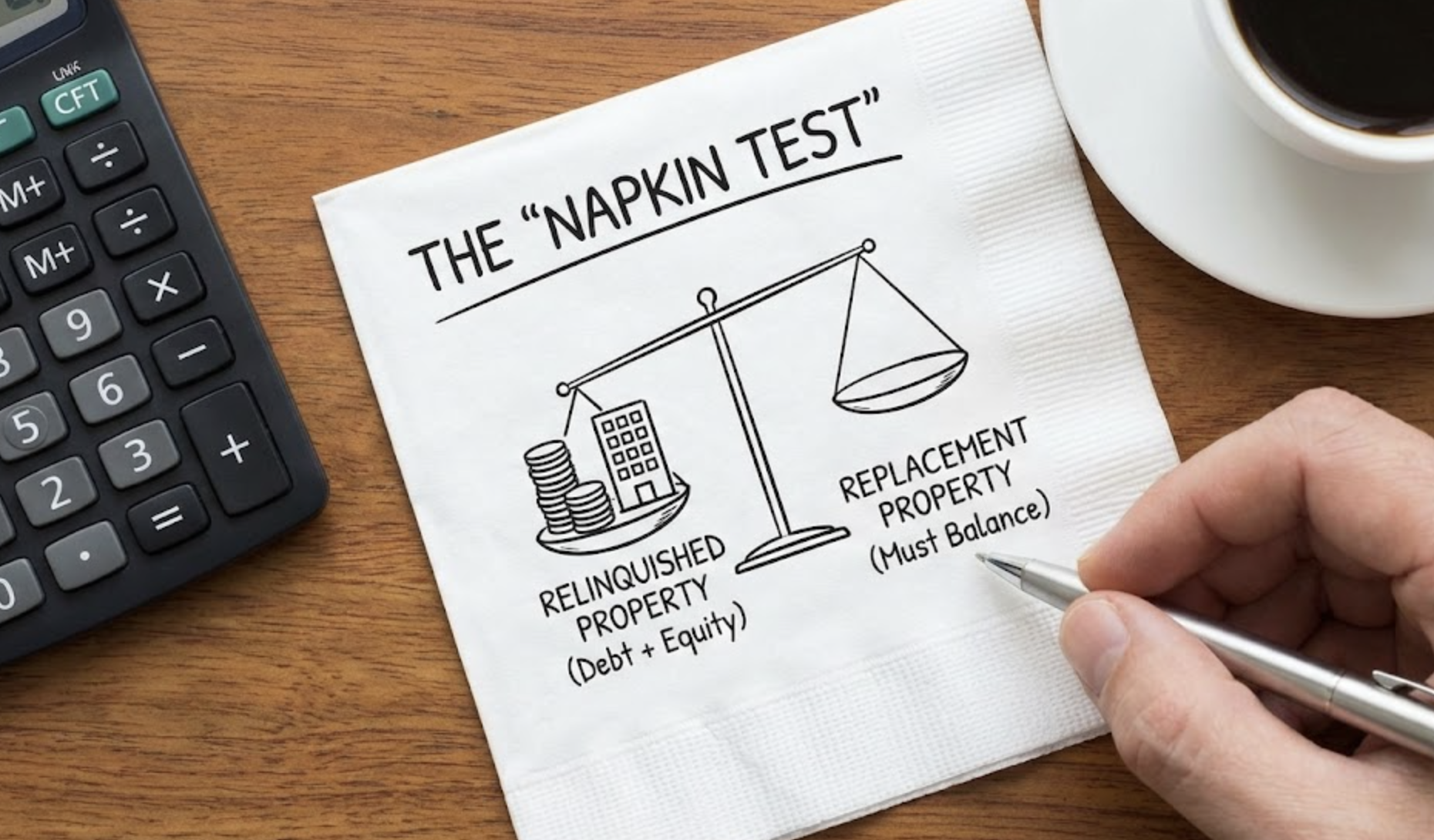
Before you ever sign a Letter of Intent (LOI), you should be able to sketch this math out on the back of a cocktail napkin. If the numbers don't balance there, they won't balance on your tax return.
This article details the "Napkin Test" formula and how to ensure your exchange equals zero tax due.
The Three Pillars of the Napkin Test
To avoid paying a single cent of capital gains tax, you must meet two non-negotiable requirements:
- Reinvest All Net Equity: Every dollar of cash that comes out of the sale must go into the purchase.
- Replace All Debt: If you had a mortgage on the old property, you must have an equal (or greater) amount of debt on the new property—OR you must bring in fresh cash to replace it.
If you fail either of these, you have "Boot."
The Formula: Determining Your "Strike Price"
The Napkin Test is simple addition. You need to know exactly what your target purchase price must be.
Step 1: Calculate Net Sale Price
- Gross Sale Price: $2,000,000
- Less Closing Costs: ($100,000) (Commissions, Title, Transfer Tax)
- = Net Sale Price: $1,900,000
Note: You generally cannot deduct operational costs like prorated rents or security deposits here. Only closing costs.
Step 2: The Target To be 100% tax-free, your Replacement Property must cost at least $1,900,000.
Step 3: The Equity & Debt Mix (The Trap) This is where people mess up.
- Old Debt Paid Off: $900,000
- Cash to QI: $1,000,000
You must buy a property worth $1.9M. You have $1M in cash. Therefore, you must find $900,000 in new financing (or liability).
Scenario A: The "Mortgage Boot" Accident
Imagine you find a great deal on a replacement property for $2,000,000.
- You are excited because $2M is greater than your $1.9M target. You think you are safe.
- The Catch: The lender requires a 50% down payment ($1M).
- The Math:
- Purchase Price: $2,000,000
- Down Payment (Exchange Cash): $1,000,000
- New Loan: $1,000,000
Result:
- Old Loan: $900,000
- New Loan: $1,000,000
- Verdict: Safe. You replaced the debt.
Now, imagine the lender requires 60% down ($1.2M).
- You only have $1M in exchange funds. You bring $200k of personal cash to close.
- New Loan: $800,000.
- Old Loan: $900,000.
- Verdict: You have $100,000 of Mortgage Boot?
- Actually, NO. The IRS allows you to offset a drop in debt by adding Cash from Pocket. Because you brought $200k in fresh cash, you are safe.
The Real Danger: You buy a cheaper property for $1,500,000 (thinking you'll just pay tax on the difference).
- Cash Used: $1,000,000
- New Loan: $500,000
- Result: You failed to spend all your equity and you failed to replace your debt. You have a massive tax bill.
The "Netting" Rules: What Cancels What?
The IRS has strict rules on what can offset what. Memorize this hierarchy:
- Cash IN offsets Mortgage Boot.
- If your new mortgage is too small, you can add personal cash to fix it.
- Mortgage UP does NOT offset Cash Boot.
- This is the fatal error.
- Scenario: You sell for $1M (with $500k equity). You buy for $1.5M (great!). But you get a giant $1.2M loan and only put down $300k of your equity, keeping $200k in your pocket.
- IRS View: You touched $200k. That is taxable Cash Boot. You cannot say, "But I took on way more debt!" The IRS doesn't care. If you touch the cash, you pay the tax.
2026 Context: High Rates & Low LTVs
In the current market, lenders are conservative. They often demand lower LTVs (Loan-to-Value) than you had on your old property.
- Old Loan: 75% LTV.
- New Loan Offer: 60% LTV.
This naturally forces you to put more equity down, which usually keeps you safe. The danger in 2026 is buying "all cash."
- If you sell a property that had a mortgage and buy the new property for 100% cash (using exchange funds + savings), you are safe (because Cash IN offsets Debt Drop).
- But if you sell a property that had a mortgage and buy a cheaper property for all cash using only exchange funds, you will have leftover cash (boot) AND unreplaced debt.
People Also Ask (FAQ)
Does the interest rate on the new loan matter? No. The IRS only looks at the principal balance. Replacing a $500k loan at 3% with a $500k loan at 8% is perfectly valid (though painful for your cash flow).
Can I use exchange funds to pay for loan fees? Generally, no. Loan origination fees, appraisal fees, and environmental reports are considered "costs of obtaining a loan," not "costs of acquiring property." If you use exchange funds to pay these, it is technically taxable boot.
- Best Practice: Bring personal cash to closing to pay for the loan fees.
What if I assume a loan? That counts! Assuming a $500k loan is mathematically identical to getting a new $500k loan.
Can I pay off my mortgage before I sell to simplify this? Be careful. If you pay off a mortgage right before closing using personal cash, it usually works. If you refinance or pay it off to manipulate the numbers, the IRS might challenge it under the "Step Transaction Doctrine."
Final Thoughts: The "Target" Number
Don't overcomplicate it. You have one number to hit. Net Sale Price.
Key Takeaway: Look at your settlement statement (HUD-1 or CD) from the sale. Find the "Net Proceeds" (Cash) and the "Payoff" (Debt). Add them together. That is your minimum purchase price. If you buy for a penny less, you must check the math. If you buy for a penny more and reinvest all the cash, you are bulletproof.