Short answer: An exchange accommodation titleholder (EAT) is a third party that takes legal title to, or "parks," property for you in a reverse or improvement 1031 exchange. Under Rev. Proc. 2000-37, the EAT can hold the property for up to 180 days while you sell your old property or build improvements, then transfers it to you.
Reviewed by Jon Hilley. Last updated September 29, 2026.
In a standard exchange, you sell first and buy second. When you need to buy first, or build on the replacement before you own it, you can't hold title to both properties yourself without breaking the exchange. The exchange accommodation titleholder solves that by owning one of the properties temporarily. It is the key party in reverse and build-to-suit exchanges, two of the more advanced types of 1031 exchanges.
The EAT is usually a single-purpose LLC set up for each transaction by the intermediary's affiliate. It holds title under a written agreement called a qualified exchange accommodation arrangement (QEAA), and it must follow the Rev. Proc. 2000-37 safe harbor for the IRS to respect it as the owner.
Key rules
- Written agreement within 5 business days: you and the EAT must sign the QEAA no later than 5 business days after the EAT acquires title (Rev. Proc. 2000-37).
- 45 days to identify: when the EAT parks the replacement, you must identify the property you will sell within 45 days of the EAT taking title (Rev. Proc. 2000-37).
- 180 days to finish: the parked property must be transferred out of the EAT, and the exchange completed, within 180 days (Rev. Proc. 2000-37).
- No parking property you already own: the safe harbor doesn't cover property you owned within the 180 days before the EAT acquires it (Rev. Proc. 2004-51).
- The EAT must be the tax owner: it must hold legal title or other qualified indicia of ownership, be subject to federal income tax, and be treated as the owner for federal income tax purposes while it holds the property (Rev. Proc. 2000-37).
- Improvements count only while parked: only construction in place when the EAT transfers the property to you counts as replacement property (Treas. Reg. §1.1031(k)-1(e)(4)).
How an EAT 1031 exchange works in a reverse 1031 exchange
Parking the replacement property (the usual reverse exchange)
The EAT buys the replacement property, typically with a loan from your lender and money you advance. You then sell your relinquished property through a qualified intermediary, and the sale proceeds are used to acquire the parked property from the EAT. This is the most common structure because it lets you close on the property you want before a buyer shows up for yours.
Parking the relinquished property
Less often, the EAT takes title to the property you are giving up, you acquire the replacement directly, and the EAT later sells the relinquished property to a buyer. This works when the replacement purchase needs to happen in your own name.
Improvement exchanges
In a build-to-suit exchange, the EAT holds the replacement property while improvements are built with exchange funds. You identify both the property and the planned construction, and the EAT deeds the improved property to you by day 180.
What the EAT can and can't be
The EAT can't be you, and it can't be a disqualified person such as your agent or a related party. The safe harbor lets you lend money to the EAT or guarantee its loan, lease the parked property from it, manage or supervise the construction, and hold fixed-price options to buy or sell the property, so you keep practical control while the EAT holds title. When the exchange finishes, the EAT transfers the property to you, typically by deed or, in some deals, by assigning its single-member LLC to you.
Financing is the practical hurdle. Your lender has to lend to the EAT's LLC rather than directly to you, and not every lender is comfortable with that. Talk to your lender early. Our pricing for a reverse exchange is $7,995, and an improvement exchange is $9,995.
If a deal can't fit inside the 180-day safe harbor, some taxpayers rely on non-safe-harbor parking arrangements, which courts have sometimes upheld (see Estate of Bartell v. Commissioner, 147 T.C. 140 (2016)). That is a higher-risk path that calls for advice from your CPA or tax attorney.
Exchange accommodation titleholder vs qualified intermediary
A qualified intermediary holds your sale proceeds in a standard exchange and is not meant to own the real estate. An EAT does the opposite: it takes title to real estate so you don't own both properties at once. A reverse exchange usually involves both, with the EAT parking the replacement and a QI handling the later sale of your relinquished property. Intermediaries that offer reverse exchanges usually provide the EAT through an affiliated single-purpose entity.
Example: a reverse 1031 exchange timeline with an EAT
Assume the EAT takes title on Monday, March 1, 2027, with no holidays that week.
- Replacement property price (parked with the EAT): $1,000,000
- Funded by: $600,000 bank loan to the EAT's LLC + $400,000 you advance to the EAT
- QEAA deadline (5 business days): March 8
- Identify property to sell (day 45): April 15
- Relinquished property net sale price: $700,000
- Mortgage paid off at sale: $300,000
- Net proceeds held by the QI: $400,000
- Deadline to take title from the EAT (day 180): August 28
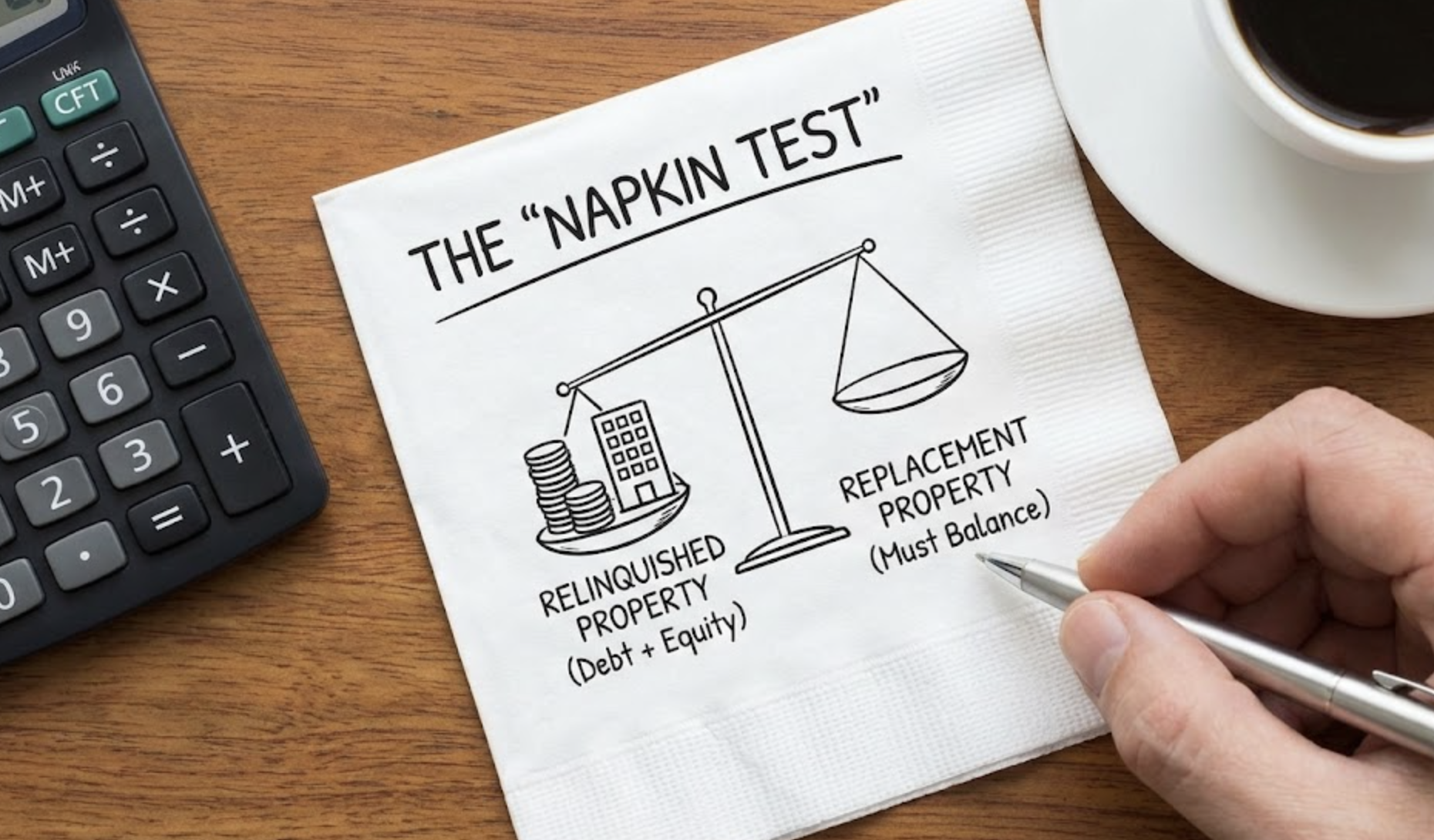
The $400,000 of exchange proceeds is applied to buy the property from the EAT, which uses it to repay your advance, and you take title subject to the $600,000 loan. You bought more ($1,000,000) than you sold ($700,000), reinvested all $400,000 of net equity, and replaced the $300,000 of debt paid off with $600,000 of new debt, so the gain on the sale is fully deferred. Track your dates with the 1031 exchange deadline tracker.
Other questions investors ask
Who is the accommodator in a 1031 exchange?
"Accommodator" is industry shorthand for the qualified intermediary, the company that holds your sale proceeds and the exchange documents. The exchange accommodation titleholder is a separate role used only in reverse and improvement exchanges. See What is a 1031 exchange facilitator?
How long do you have to hold a replacement property after a 1031 exchange?
There is no fixed minimum in the law. What matters is that you acquired the property to hold for investment or business use, and many advisors suggest at least 1 to 2 years. See What happens when you sell a 1031 exchange property later?
Common mistakes
- Calling us after closing: we see investors who close on the replacement in their own name and then ask for a reverse exchange. Once you hold title, the EAT can't take it.
- Waiting on lender approval: the most common delay we see is a lender that learns late it must lend to the EAT's LLC. Get that answer before you sign the purchase contract.
- Assuming construction can finish later: in an improvement exchange, work done after the EAT deeds the property to you doesn't count, which can leave you with boot.