1031 Exchange Rules for Multiple Owners: Co-Ownership, Partnerships, and Entity Structures
A 1031 exchange under IRC §1031 defers capital gains tax when you swap one investment property for another of like-kind. The mechanics get substantially more complex when the property has multiple owners, because the IRS applies a strict "same taxpayer" rule: whoever sells the relinquished property must be the one to acquire the replacement property. That rule, combined with partnership tax treatment under IRC §708, creates the central challenge for every multi-owner exchange.
This article walks through how the rules actually apply, what ownership structures work (and don't), and how to handle the most common scenarios co-owners face when some want to exchange and others want to cash out.
The Legal Framework
Before addressing structure, it helps to know the code sections that govern this area:
- IRC §1031(a)(1) establishes the like-kind exchange itself and the same-taxpayer requirement.
- IRC §708 governs partnership continuation and termination, and defines when a partnership is treated as a single taxpayer distinct from its partners.
- Treasury Regulation §1.1031(a)-1 provides the detailed rules for what qualifies as like-kind property.
- Revenue Procedure 2002-22 sets out the IRS safe harbor conditions for a tenancy-in-common (TIC) arrangement to be respected as co-ownership rather than reclassified as a partnership.
- Revenue Ruling 2004-86 confirms that a properly structured Delaware Statutory Trust (DST) interest qualifies as a like-kind replacement property.

Every decision discussed below traces back to one of these authorities.
Holding Title: Individual vs. Entity Ownership
The starting point for any multi-owner exchange is how title is held. The choice drives everything downstream: who the "taxpayer" is for 1031 purposes, whether co-owners can make independent exchange decisions, and what restructuring (if any) has to happen before the sale.
Individual co-ownership (tenancy in common)
When each co-owner holds title individually as a tenant in common, each owner is treated as a separate taxpayer. Each can independently decide whether to participate in a 1031 exchange, identify their own replacement properties, and use their own qualified intermediary. This flexibility is the single biggest advantage of TIC ownership for investors with divergent goals.
The trade-off is coordination friction. Each owner must engage a separate QI with a segregated exchange account. Each must meet the 45-day identification and 180-day closing deadlines independently. And the TIC structure itself has to pass IRS scrutiny under Rev. Proc. 2002-22, or the IRS can reclassify it as a partnership and collapse everyone's exchanges.
Entity ownership (LLC, LP, partnership)
When the property is held by an LLC, limited partnership, or general partnership, the entity is the taxpayer under IRC §708, not the individual members. This means the entity can conduct a 1031 exchange, but individual members cannot conduct separate exchanges on their membership interests. Everyone inside the entity is along for the same ride.
Single-member LLCs are the exception: the IRS treats them as disregarded entities, so the individual member remains the taxpayer for 1031 purposes.
Quick comparison of ownership structures
StructureTaxpayer for 1031Independent exchange by each owner?Co-owner capKey riskTenancy in Common (TIC)Each co-ownerYes35 (under Rev. Proc. 2002-22)IRS reclassification as partnership if structure fails safe harborSingle-member LLCThe member (disregarded)N/A (one owner)1None specific to 1031Multi-member LLCThe LLCNo (entity-level only)No hard capIndividual members cannot exit with tax-deferred status without restructuringLimited PartnershipThe partnershipNoNo hard capSame partnership problem as LLCDelaware Statutory Trust (DST)The trust (treated as grantor trust)Each beneficial owner is treated as owning an undivided interestUp to ~500 typicalMust comply with Rev. Rul. 2004-86; limited investor control
The practical takeaway: if you want each co-owner to make independent exchange decisions, TIC is usually the vehicle. If you want centralized decision-making, an LLC works, but everyone's exchange fate is linked.
The Partnership Problem: Why Individual Partners Can't Do Their Own Exchange
This is the single most common source of confusion for multi-owner property. Under IRC §708, a partnership is treated as a single taxpayer. When the partnership sells property, only the partnership itself can do a 1031 exchange on the proceeds. Individual partners cannot peel off their share and conduct an independent exchange, even if they own 50% of the partnership.
For many investors, this is a deal-breaker. Say a three-member LLC owns a $3M rental property. One member wants to 1031 into a replacement, one wants to cash out and retire, and one wants to take their share in cash and invest in a business. The LLC can either do a single entity-level exchange (meaning all three must agree on a replacement property) or dissolve and restructure before the sale. There's no middle ground at the entity level.
The workarounds are "drop and swap" and "swap and drop," both discussed below.
Rev. Proc. 2002-22: The TIC Safe Harbor
If co-owners want to hold property as tenants in common and be treated as individual taxpayers for 1031 purposes, their arrangement must not look like a partnership in substance. Revenue Procedure 2002-22 provides a safe harbor with 15 conditions. Meet all of them, and the IRS will issue a private letter ruling confirming TIC treatment. Structure your deal around these conditions (without necessarily requesting the PLR), and you significantly reduce the risk of reclassification.
The most important conditions in practice:
- No more than 35 co-owners. This is a hard cap.
- The co-ownership cannot file a partnership tax return. No Form 1065, no K-1s issued to co-owners from the TIC.
- Co-owners must hold title as tenants in common under applicable state law, not through a partnership or LLC.
- All co-owners must agree unanimously on material decisions like selling, leasing to a new tenant, or negotiating a loan.
- Each co-owner must share profits, losses, and proceeds in strict proportion to their undivided interest. No special allocations, no preferred returns.
- Each co-owner must bear their proportionate share of debt and have the right to partition the property.
- The TIC cannot conduct business activities beyond what's customary for rental real estate. Active management of a hotel or short-term rental portfolio, for example, can push a TIC into partnership territory.
Fail these conditions and the IRS can recharacterize your TIC as a de facto partnership under IRC §761, which destroys the individual-taxpayer treatment and voids any 1031 exchanges the individual co-owners attempted.
Most sophisticated TIC structures are drafted by attorneys specifically around these 15 conditions. If your deal came together informally or without legal review, it's worth having counsel audit the arrangement before anyone relies on 1031 treatment.
Drop-and-Swap: Converting Partnership Interests to TIC Before the Exchange
When partners in an LLC or partnership want different outcomes, the most common workaround is the drop-and-swap. The mechanics:
- Before the sale of the property, the partnership distributes the property to the individual partners as tenants in common (the "drop"). Each partner now holds a direct undivided TIC interest in the real estate.
- The TIC co-owners then sell the property. Each owner decides independently whether to do a 1031 exchange on their share (the "swap") or take cash and pay tax.
- Partners who exchange identify replacement properties and close within the 45-day and 180-day windows, using their own qualified intermediaries.
This works in theory, but the IRS scrutinizes the timing aggressively. The concern is that a drop-and-swap executed right before a sale looks like a disguised partnership-level exchange followed by a distribution, which the "same taxpayer" rule prohibits.
The holding period problem
There is no bright-line safe harbor for how long TIC interests must be held after the drop before the sale. The conservative position among tax practitioners is 12 to 24 months. Case law, including Chase v. Commissioner and Bolker v. Commissioner, suggests that holding periods as short as a few months have survived IRS challenge when the facts support genuine ownership by the individual partners, but these cases are fact-specific and not authoritative safe harbors.
Practical guidance: if the drop happens more than two years before the sale, the position is strong. Less than a year, expect IRS scrutiny and have your facts well-documented. Days or weeks before a sale, the position is aggressive and the exchange may fail.
Swap-and-Drop: The Reverse Approach
The swap-and-drop flips the sequence. The partnership completes a 1031 exchange at the entity level, acquires the replacement property, and then distributes TIC interests in the replacement to individual partners after some holding period.
This structure is sometimes preferred when the partnership as a whole wants to exchange but the partners plan to separate afterward. The IRS scrutiny here focuses on whether the partnership continued to hold the replacement property for investment purposes under IRC §1031(a)(1). If the distribution happens immediately after acquisition, the IRS can argue the partnership never held the replacement property for investment and invalidate the exchange.
Same practical guidance applies: the longer the entity holds the replacement property before distributing TIC interests, the stronger the position. One to two years is the common recommendation.
Delaware Statutory Trusts: The Exit Valve When Co-Owners Can't Agree
When co-owners cannot agree on a replacement property, or when the 45-day identification deadline is running out and nothing suitable has been found, a Delaware Statutory Trust can solve the problem. Under Revenue Ruling 2004-86, a DST interest qualifies as like-kind real property for 1031 purposes.
A DST is a passive investment vehicle where a sponsor (typically a large real estate operator) holds institutional-quality property and sells fractional beneficial interests to accredited investors. Each co-owner can independently 1031 into DST interests of different sponsors if they want, or into the same DST, without needing agreement on a specific replacement property.
Key points on DSTs:
- Minimum investments typically run $25,000 to $100,000 per DST.
- Investors are accredited only (generally $1M+ net worth excluding primary residence, or $200K+ individual income).
- Investors have no operational control; the sponsor manages everything.
- Typical hold periods are 5 to 10 years before the sponsor sells and distributes proceeds, at which point investors can 1031 again or take the gain.
- Fees and sponsor promote reduce net returns compared to direct ownership.
For co-owners who cannot reach consensus or who want passive replacement property, DSTs are often the cleanest exit.
Qualified Intermediary Requirements for Multiple Owners
Every taxpayer in a multi-owner exchange must have their own QI, and each QI must hold that taxpayer's exchange funds in a separate, segregated account. For a three-person TIC, that's three separate QI engagements and three separate exchange accounts, even if all three co-owners are exchanging into the same replacement property.
This is non-negotiable under Treasury Regulation §1.1031(k)-1(g)(4). Commingling exchange funds across co-owners destroys the safe harbor and triggers constructive receipt, which collapses the exchange.
Co-owners can use the same QI firm if they prefer. The firm sets up separate accounts, separate exchange agreements, and separate documentation for each taxpayer.
Boot Allocation Among Co-Owners
When co-owners end up with unequal cash or debt outcomes, boot gets recognized at the individual owner level (or entity level, in the case of LLCs). A few scenarios:
Unequal debt replacement. If the relinquished property had $500K of debt allocated proportionally to three TIC owners, and two owners take on replacement debt of $170K each while the third only takes on $100K, the third owner has $67K of mortgage boot ($167K share reduced to $100K). The first two owners have no boot.
Unequal cash taken. If one co-owner decides to take $50K in cash at closing while the others reinvest fully, that co-owner recognizes $50K of cash boot. The others recognize nothing.
Equalization agreements. Co-owners often use equalization agreements to manage these differences. The agreement allocates sale expenses, proceeds, and any boot among the owners based on their actual economic positions rather than strict proportional interest. This can't eliminate boot recognition (the IRS looks at actual tax attributes), but it can make the economic outcome fair when debt, capital improvements, or depreciation differ across owners.
Identification Rules for Multi-Owner Exchanges
Every taxpayer in a multi-owner exchange independently applies the identification rules within 45 days of the relinquished property's sale. The three methods:
RuleHow It WorksBest ForThree-Property RuleIdentify up to 3 replacement properties of any valueMost investors; simplest to execute200% RuleIdentify any number of properties, as long as aggregate FMV ≤ 200% of relinquished property's sale priceInvestors wanting flexibility to identify more than three options95% ExceptionIdentify unlimited properties exceeding 200% of value, but must acquire 95% of total identified valueRarely used; high execution risk
In a TIC structure, each co-owner applies these rules to their own share. In an entity-level exchange, the entity applies them to the entire property. The 180-day closing deadline runs concurrently with the 45-day identification window, both starting from the closing date of the relinquished property. Note that if your tax return due date (typically April 15, or the extended deadline if you file for extension) falls before Day 180, you must close by the earlier date unless you file for the extension.
Case Study: Sarah and Michael's $2M Exchange
Sarah and Michael jointly own a commercial property through a two-member LLC, with each holding a 50% membership interest. They bought the property in 2015 for $1.2M ($200K allocated to land, $1M to building). Accumulated depreciation through 2026 totals approximately $282,000 ($1M ÷ 39 years × 11 years). Their adjusted basis is $918,000. The property sells for $2M with $80K in closing costs, giving them a realized gain of roughly $1,002,000.
They have two paths.
Path A: Entity-level exchange. The LLC sells the relinquished property and, within 180 days, acquires a $2.1M replacement retail building. Both Sarah and Michael remain members of the LLC with their 50% interests intact. The LLC defers the full gain. This is the simplest structure, but it locks them together going forward.
Path B: Drop-and-swap. 18 months before the sale (Sarah and Michael plan ahead), the LLC distributes the property to Sarah and Michael as tenants in common, with each holding a 50% undivided interest. They each engage their own QI when the property sells. Sarah exchanges her $1M share into a replacement rental near her home. Michael, who wants to retire soon, exchanges his share into a DST for passive income. The 18-month holding period strengthens their position against IRS scrutiny, and each executes an independent exchange.
In both paths, they defer the full $1,002,000 gain. The difference is flexibility. Path A is simpler but binds them together. Path B requires advance planning but lets them pursue different goals.
If they had tried the drop-and-swap two weeks before closing, the IRS could reasonably argue that Sarah and Michael never held genuine TIC interests and that the exchanges were really disguised partnership-level events, which would invalidate both exchanges and trigger $1M+ of immediate recognition.
State Tax Conformity Considerations
Most states conform to federal 1031 treatment, but a few don't fully, and the complications compound in multi-owner exchanges where co-owners live in different states.
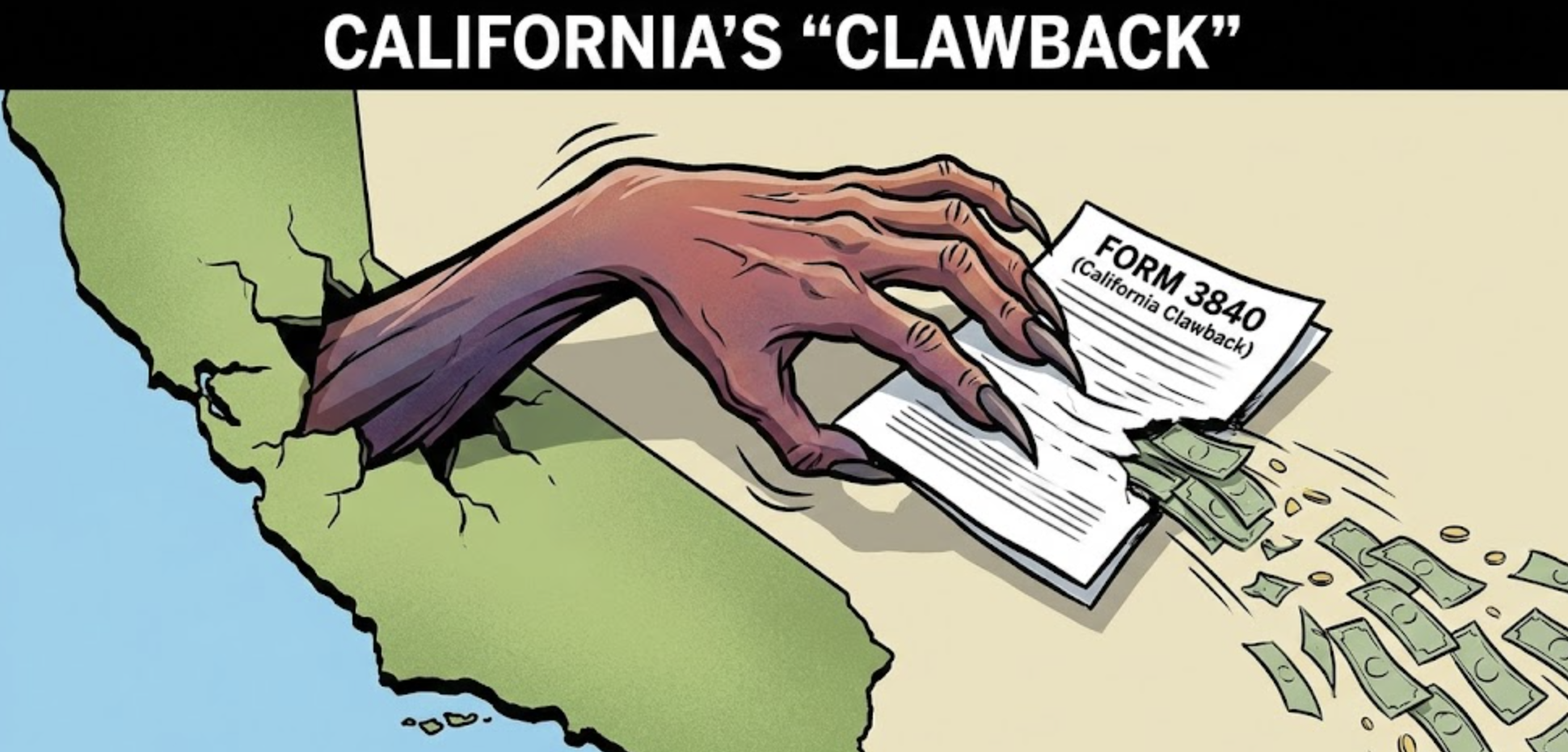
- California requires FTB Form 3840 to be filed annually when a California property is exchanged for an out-of-state replacement. California claws back the deferred gain when the replacement property is eventually sold, regardless of where the replacement is located.
- Pennsylvania historically did not conform to federal 1031 treatment for individual taxpayers, though legislation has evolved. Verify current rules with a Pennsylvania CPA.
- Massachusetts, New York, and Oregon each have nuances around non-resident withholding and reporting that can affect out-of-state co-owners.
If Sarah lives in California and Michael lives in Texas, and they're exchanging a California property, Sarah has ongoing Form 3840 obligations and clawback exposure; Michael doesn't. The state-level asymmetry is often overlooked and can produce surprising tax bills years later.
A Decision Framework for Multi-Owner Exchanges
The right approach depends on what the co-owners actually want. A few practical decision points:
All co-owners agree on the replacement property and want to stay together. Entity-level exchange (LLC, LP, or partnership). Simplest, cleanest, no restructuring needed.
Co-owners want different replacement properties but all want to exchange. TIC structure (either already in place or via drop-and-swap with adequate holding period). Each owner uses their own QI and identifies independently.
Some co-owners want to exchange, others want to cash out. Drop-and-swap with the cashing-out owners simply taking their TIC share proceeds and paying tax. Or, if the exchanging owners are willing, the entity can refinance before the sale to cash out the departing owners, then do an entity-level exchange with the remaining owners.
No consensus on a replacement property, or the 45-day window is closing. DST interests as replacement property. Each owner can select their own DST sponsor independently.
Partnership already in place, sale is imminent (less than 12 months out). High-risk scenario. Consult tax counsel immediately. Options narrow significantly under tight timing.
Frequently Asked Questions
Can individual partners in an LLC or partnership do their own 1031 exchange on a property the entity owns?
No. Under IRC §708, the partnership or LLC is the taxpayer, and only the entity itself can conduct a 1031 exchange. Individual partners cannot conduct separate exchanges on their partnership interests. The drop-and-swap strategy is the standard workaround, but it requires converting the partnership to a TIC structure before the sale, ideally with a holding period of 12 to 24 months to withstand IRS scrutiny.
What happens if one co-owner wants to cash out while others want to exchange?
In a TIC structure, the cashing-out owner simply takes their proportionate share of sale proceeds and pays capital gains tax on their share, while the other co-owners proceed with independent exchanges. In an LLC or partnership, this is more complex: the entity must either restructure (drop-and-swap), refinance to cash out the departing owner before the sale, or have the departing owner sell their membership interest (which is a taxable event but doesn't involve a 1031 exchange).
Does a 1031 exchange work if ownership percentages change between the relinquished and replacement property?
Not fully. The same-taxpayer rule requires that whoever sold the relinquished property must acquire the replacement property. If ownership percentages shift (for example, from a 50/50 TIC to a 60/40 split in the replacement), the portion representing the change in ownership is treated as a taxable event for the owner whose interest decreased. Equalization agreements can address the economics but cannot eliminate the tax consequence of the shift.
What is a Delaware Statutory Trust and how does it help co-owners who cannot agree on a replacement property?
A DST is a passive real estate investment vehicle recognized under Revenue Ruling 2004-86 as qualifying like-kind property. Each co-owner can independently exchange into different DST sponsors or the same DST, without needing consensus on a specific replacement property. DST investments are passive (no operational control), require accredited investor status, and typically have 5 to 10 year hold periods before the sponsor sells and distributes proceeds.
How many replacement properties can co-owners identify during the 45-day identification period?
Each taxpayer applies the identification rules independently. In a TIC, each co-owner can identify up to three replacement properties under the Three-Property Rule, or use the 200% Rule or 95% Exception. In an entity-level exchange, the entity applies these rules once to the full property value. This means a TIC gives each co-owner their own set of three identifications, which multiplies the flexibility when co-owners have different preferences.
What are the risks of a drop-and-swap strategy, and how long should co-owners hold TIC interests before selling?
The primary risk is IRS recharacterization. If the drop-and-swap happens too close to the sale, the IRS can argue the transaction was really a partnership-level exchange followed by a distribution, which fails the same-taxpayer rule. There is no bright-line safe harbor, but most tax advisors recommend holding TIC interests for at least 12 to 24 months before the sale. The longer the holding period, the stronger the position.
Do all states recognize federal 1031 exchange deferral for co-owned properties?
No. California, Pennsylvania (historically), Massachusetts, New York, and Oregon all have state-level rules that can produce additional tax even when federal tax is deferred. California's Form 3840 clawback is the most notable: if a California property is exchanged for an out-of-state replacement, California claws back the deferred gain when the replacement is eventually sold, and the taxpayer must file Form 3840 annually in the interim. Co-owners residing in different states face asymmetric state tax outcomes on the same exchange.
Can multiple owners use the same qualified intermediary?
They can use the same QI firm, but each taxpayer must have a separate QI engagement and a segregated exchange account under Treasury Regulation §1.1031(k)-1(g)(4). Commingling exchange funds across co-owners destroys the qualified escrow safe harbor and triggers constructive receipt, which invalidates the exchange. Most established QI firms are set up to handle multi-party TIC exchanges with appropriate account segregation.
Q: What are the basic 1031 exchange rules for multiple owners of investment property?
A: When multiple owners hold an investment property, Section 1031 still applies, but with additional considerations. Each owner must independently meet all requirements of a 1031 exchange. This means each investor must identify replacement properties within 45 days of the sale of the relinquished property and complete the acquisition within 180 days. Additionally, all owners must maintain the same ownership structure in the replacement property as they had in the relinquished property, unless they perform specific restructuring before the exchange. The full value of the relinquished property must be reinvested to avoid any immediate tax consequences, and all parties must work with a qualified intermediary to properly handle the 1031 exchange funds.
Q: How can multiple investors complete a 1031 exchange if some owners want to go their separate ways?
A: When some co-owners want to exit while others wish to proceed with the exchange, a "drop and swap" strategy is often employed. This involves restructuring ownership before the sale, where: 1. The partnership "drops" the departing owners' interests, converting the ownership from a partnership to a tenancy-in-common (TIC). 2. Those continuing with the 1031 exchange can then reinvest their proceeds into a new property while maintaining their tax-deferred status. 3. Exiting owners simply take their portion of the sale proceeds and pay applicable taxes. This restructuring should ideally occur well before the sale (preferably months) to avoid IRS scrutiny. Working with tax professionals experienced in 1031 exchanges for multiple owners is essential to properly execute this strategy.
Q: Can I use a 1031 exchange for multiple properties with multiple owners?
A: Yes, you can use a 1031 exchange for multiple properties with multiple owners. The IRS allows investors to exchange one property for multiple replacement properties or multiple properties for one replacement property. When multiple owners are involved, each owner must follow the identification rules independently. Each investor can identify up to three properties of any value (3-property rule) or any number of properties as long as their combined value doesn't exceed 200% of the sold property's value (200% rule). All ownership interests must be properly documented, and each owner must maintain their proportional interest throughout the exchange unless a proper restructuring occurred before the sale of the relinquished property.
Q: What is a "drop and swap" in the context of a 1031 exchange with multiple owners?
A: A "drop and swap" is a strategy used when co-owners of real property want different outcomes from the sale. This technique allows some investors to keep their 1031 exchange benefits while others cash out. The process involves: 1. "Dropping" the property from a partnership structure to a tenancy-in-common arrangement. 2. Each owner then takes direct title to their proportionate share of the property. 3. When the property is sold, those wanting to exchange can direct their portion of proceeds toward replacement properties. 4. Those wanting to cash out simply receive their proceeds and pay taxes accordingly. The IRS scrutinizes these arrangements closely, so timing is crucial—ideally, this restructuring should happen well before (several months) any sale contracts are signed.
Q: What are the 1031 exchange rules for identifying replacement properties when multiple owners are involved?
A: When multiple owners participate in a 1031 exchange, each owner must independently comply with the identification rules. Each investor has 45 days from the sale of the relinquished property to identify potential replacement properties using one of these methods: 1. Three Property Rule: Identify up to three properties regardless of value. 2. 200% Rule: Identify any number of properties as long as their combined value doesn't exceed 200% of the sold property's value. 3. 95% Rule: Identify any number of properties of any value, but acquire at least 95% of the total value identified. Each owner can choose their own replacement properties, allowing for flexibility where multiple partners have different investment goals. However, all identified properties must be properly documented and submitted to the qualified intermediary within the 45-day window.
Q: How can I structure a 1031 exchange with a private equity investor for jointly owned property?
A: Structuring a 1031 exchange with a private equity investor for jointly owned property requires careful planning: 1. Determine ownership interests: Clearly document each party's ownership percentage in the relinquished property. 2. Create the right entity structure: Often a tenancy-in-common (TIC) or Delaware Statutory Trust (DST) works best for accommodating both private equity and individual investors. 3. Negotiate replacement property terms: Ensure the operating agreement addresses control rights, management responsibilities, exit strategies, and profit distributions. 4. Consider using a Delaware Statutory Trust: This can be advantageous as it allows accredited investors to own fractional interests in institutional-quality real estate investments while maintaining 1031 eligibility. 5. Engage qualified professionals: Work with attorneys and tax advisors specializing in complex 1031 transactions to ensure compliance with all regulations and protect the tax benefits for all parties.
Q: What happens if one owner in a multiple-owner real estate investment wants to sell their interest in the property?
A: When one owner wants to sell their interest in a jointly owned property while others wish to maintain ownership, several options exist: 1. Buy-out arrangement: Other owners can purchase the departing owner's interest directly. This is a taxable event for the selling owner but doesn't trigger a 1031 exchange scenario. 2. Partial 1031 exchange: If all owners agree to sell the entire property, the continuing investors can use their portion of proceeds in a 1031 exchange while the departing owner takes their proceeds as a taxable sale. 3. Refinancing before sale: The property could be refinanced to provide cash to the departing owner, effectively reducing their equity interest before any future 1031 exchange. 4. Partnership division: The partnership could be divided into two entities, with the departing owner receiving a specific property that they can then sell independently. Each option has different tax implications, so consultation with tax professionals experienced in 1031 exchanges is crucial.
Q: How can multiple owners ensure they all receive the tax benefits of a 1031 exchange?
A: For multiple owners to ensure they all receive the tax benefits of a 1031 exchange, they should: 1. Maintain consistent ownership structures between relinquished and replacement properties 2. Ensure each owner uses a separate qualified intermediary account to handle their portion of exchange funds 3. Have each owner separately identify replacement properties within the 45-day identification period 4. Ensure all owners acquire replacement property of equal or greater value than their portion of the relinquished property 5. Reinvest all proceeds (to defer all taxes) or handle any cash boot separately for each owner 6. Document everything meticulously, including ownership percentages and capital contributions 7. Consider using a tenancy-in-common agreement rather than a partnership structure, as partnerships technically cannot perform 1031 exchanges (the partnership entity itself must do the exchange) 8. Consult with tax professionals who specialize in complex 1031 exchange scenarios with multiple ownership interests.
Multi-owner 1031 exchanges reward advance planning. The structural choices made months or years before a sale, particularly around TIC versus partnership treatment and drop-and-swap timing, determine what options are available when the property actually sells. If your co-ownership structure was set up without 1031 planning in mind, it's worth having the structure reviewed by a qualified tax advisor well before any sale becomes imminent.
For a specific-scenario review, you can request a consultation and we'll walk through the structure, timing, and exchange options for your ownership group.