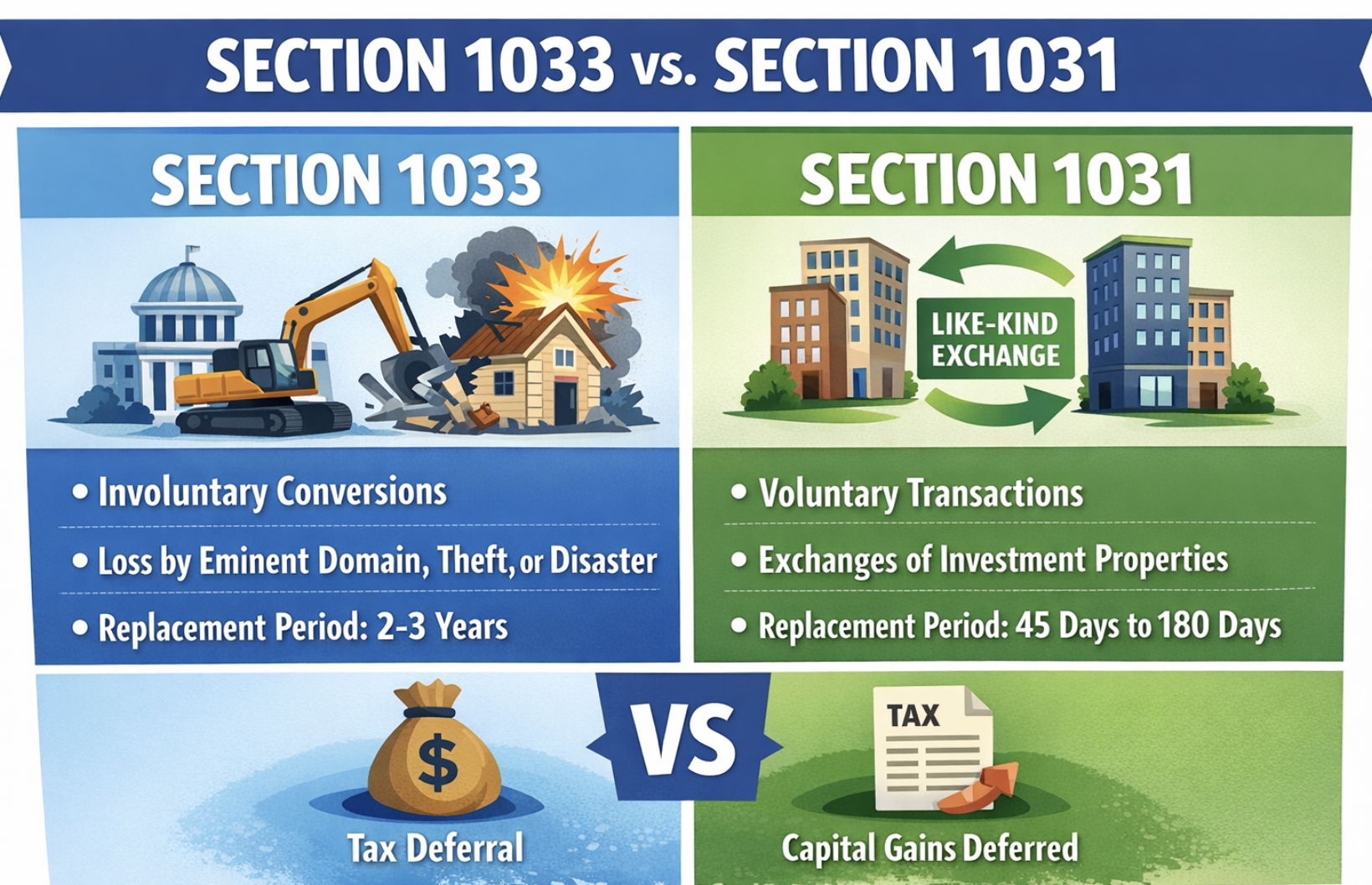
The Tax That Follows You Forever: Understanding California’s Reach Beyond State Lines
There is a popular myth in real estate circles: "If I sell my California apartment building and 1031 exchange into a property in Texas or Florida, I am done with California taxes."
This is dangerous misinformation.
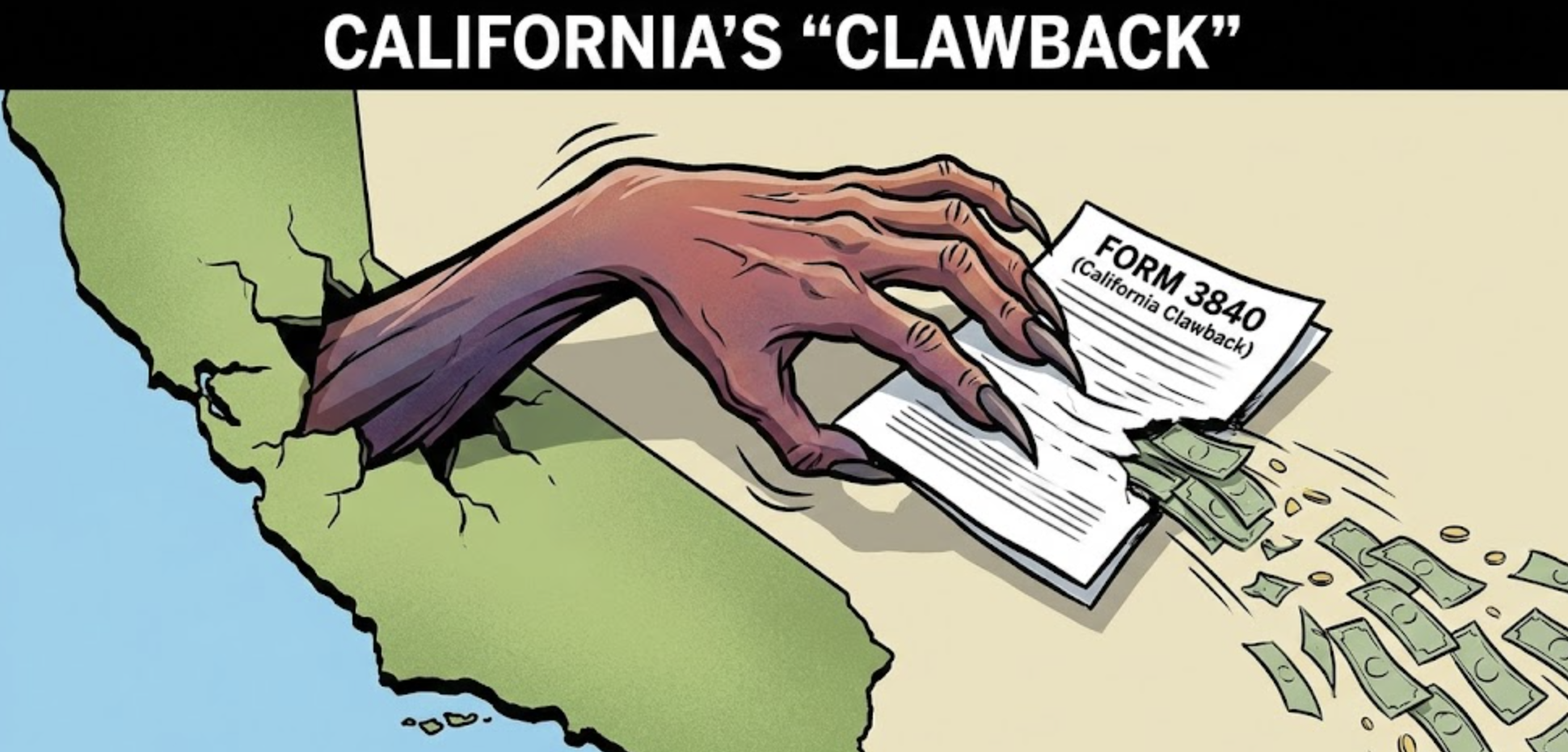
California is one of the few states with a "sticky" tax policy known as the Clawback Provision. Under California Revenue and Taxation Code Sections 18032 and 24953, the Franchise Tax Board (FTB) takes the position that if you accrued wealth while your property sat on California soil, that wealth belongs to California—forever.
It does not matter if you move to Nevada. It does not matter if your new property is in Tennessee. If you eventually sell that out-of-state replacement property for cash, California demands its cut of the original deferred gain.
The mechanism they use to track you is Form 3840. In 2026, with the state facing budget deficits, the FTB has weaponized this form with new AI-driven audit tools to find investors who have "forgotten" to file.
This article details how the Clawback works, the lifelong reporting burden it creates, and the severe penalties for ignoring it.
The Mechanism: How the "Clawback" Works
When you perform a 1031 exchange moving capital out of California, you are essentially carrying a "tax backpack" filled with your California deferred gain.
The Scenario:
- 2015: You bought a duplex in Los Angeles for $1,000,000.
- 2026: You sell it for $2,000,000.
- Gain: You have a $1,000,000 capital gain.
- The Exchange: You 1031 exchange into an apartment complex in Austin, Texas, worth $2,000,000.
The Misconception: You owe zero tax today. You are now a Texas investor.
The Reality: You have deferred the federal tax, but you have only paused the California tax. That $1,000,000 gain is "California-sourced income."
- If you sell the Texas property in 2030 for cash, you will owe federal capital gains tax.
- You will also owe California state income tax (up to 13.3% or more) on the original $1,000,000 gain, even if you have not set foot in California for four years.
Form 3840: The Annual Tracking Device
To ensure you don't "forget" to pay this tax in the future, California requires you to file FTB Form 3840 (California Like-Kind Exchanges).
Most investors assume this is a one-time filing in the year of the sale. This is incorrect.
You must file Form 3840 every single year that you hold the replacement property. It is an annual information return that signals to the FTB: "I still own the property in Texas. I have not cashed out yet. Please keep my file open."
Who Must File?
- Any taxpayer (resident or non-resident) who exchanges California property for non-California property.
- This applies to individuals, LLCs, partnerships, corporations, and trusts.
When Does the Filing Requirement End?
The requirement to file Form 3840 only stops when:
- You Sell and Pay: You sell the out-of-state property in a taxable transaction and pay California the tax due.
- Death: The owner dies, receiving a "step-up in basis," which generally eliminates the deferred tax liability.
- Donation: The property is donated to a non-profit.
The "Chain of Exchanges" Trap
A common question in 2026 is: "What if I exchange the Texas property for a property in Florida?"
The liability travels with the money.
- If you swap California $\to$ Texas, you file Form 3840 for the Texas property.
- If you later swap Texas $\to$ Florida, you continue to file Form 3840, now listing the Florida property.
- You must report the accumulated California deferred gain on the new form.
You cannot "wash" the California taint by laundering the money through multiple states. The FTB tracks the chain of title and the deferred gain basis across every transaction.
The 2026 Enforcement Landscape: Why This Matters Now
For years, Form 3840 compliance was on the "honor system." Many investors ignored it without consequence. That has changed.
1. The EDR2 System
The FTB has implemented the Enterprise Data to Revenue (EDR2) project. This AI-driven system cross-references federal 1031 filings (Form 8824) with state filings. If the IRS data shows you sold a California property in a 1031 exchange but the FTB sees no Form 3840 attached to your state return, an automatic notice is generated.
2. The "Failure to File" Penalty
If you fail to file Form 3840, the FTB can assess a "failure to furnish information" penalty. Worse, they may simply estimate your income and send you a bill for the entire tax amount, assuming you cashed out.
- The Nightmare Scenario: You exchange into Texas but don't file Form 3840. Three years later, the FTB sends a Notice of Proposed Assessment demanding $133,000 in taxes + interest + penalties, assuming you sold the property. You then have the burden of proof to show you didn't sell it.
3. Real Property Limitation
As of 2025, California strictly conforms to federal law limiting 1031 exchanges to real property only. The previous loopholes for personal property (for certain income levels) are fully closed. Ensure your allocation of value in the exchange does not include "boot" from furniture or equipment, as California will tax that immediately.
People Also Ask (FAQ)
Does California tax the growth that happens outside of California?
Generally, no. California only claws back the gain that accrued while the property was in California.
- Example: You have $1M gain from California. You move to Texas. The Texas property grows by another $500k. When you cash out, you owe California tax on the $1M, but not on the $500k of Texas growth. (Note: You will likely owe no state tax on the $500k because Texas has no state income tax).
What if I move back to California?
If you move back and become a California resident again, you are taxed on worldwide income. If you sell the property while a resident, California will tax the entire gain (the original $1M plus the $500k Texas gain).
Do I have to file a California tax return (Form 540) just to file Form 3840?
If you have no other California income, you file Form 3840 as a standalone information return. However, most tax software will generate a non-resident return (Form 540NR) to attach it to.
Can I avoid this by waiting until I die?
Yes. "Swap 'til you drop" is the ultimate defense against the California Clawback. If you hold the replacement property until death, your heirs receive a step-up in basis to the current market value, wiping out both the federal and the California deferred tax liability.
Final Thoughts: The Compliance Cost of Leaving
Moving your capital out of California is a legitimate wealth preservation strategy, but it comes with a tail.
Key Takeaway: If you have exchanged out of California in the last 10 years, check your tax returns.
- Look for Form 3840.
- If it is missing, contact your CPA immediately to file catch-up forms.
- Do not assume the FTB has forgotten about you. Their memory—and their statute of limitations on non-filers—is effectively infinite.